

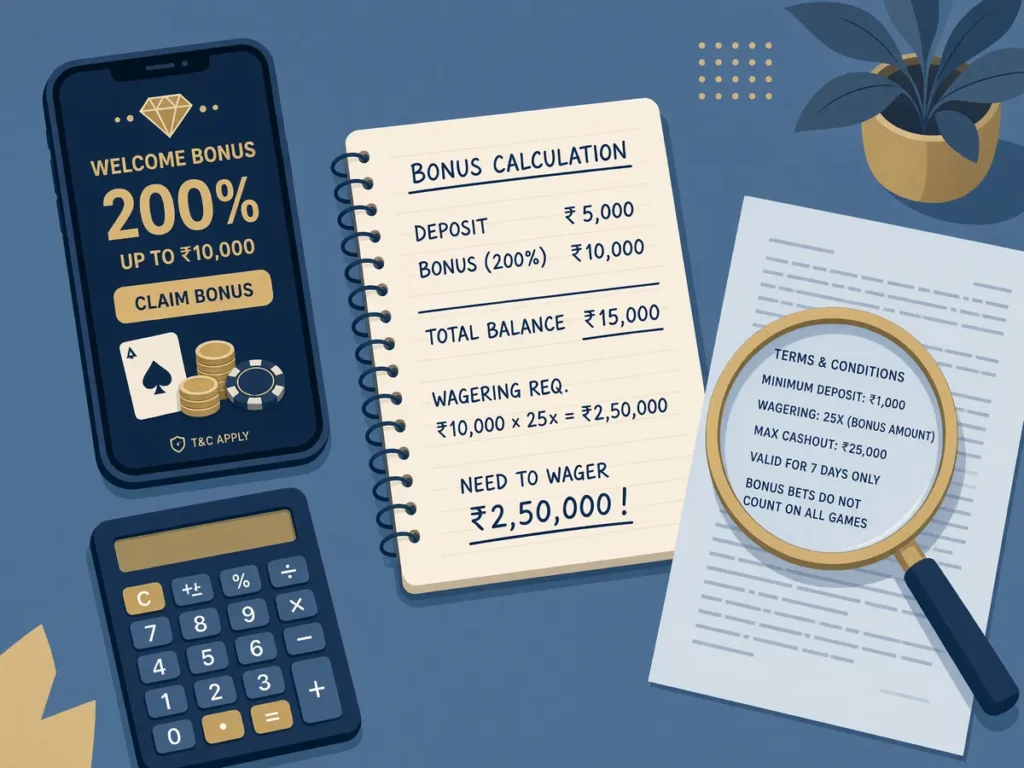
The bonus percentage is the least useful number on the offer
A wagering requirement is the amount you must bet before bonus money (or anything you win with it) can be withdrawn, written as a multiplier: 30x, 40x, sometimes worse. It is the number that decides whether a bonus is worth claiming, and it is almost never the number in the banner. A 400% match looks five times better than a 100% match. Run the turnover math on both and the 100% offer often wins.
That gap matters most during festive promo season, when offers stack up and the headline figures get louder. So here is the skill worth more than any single offer: how to read a casino bonus terms sheet, in rupees, in about two minutes, and decide for yourself. Five levers do almost all the work, and one of them is the one people forget to check.
What the multiplier actually costs you in rupees
Multiply the bonus by the multiplier and you get the turnover you owe. A ₹1,000 bonus at 30x means ₹30,000 of bets placed before a withdrawal is possible. That is total stakes cycled, not money lost: each ₹100 spin chips ₹100 off the requirement, win or lose, and whatever is left in your balance keeps funding the next spin.
Until that turnover is done, the bonus is not yours. Most sites let you withdraw your own deposit and forfeit the bonus (that is a non-sticky bonus); with a sticky bonus, the bonus amount itself never becomes cash at all, only the winnings above it do. Check which one you have before you plan an exit.
Now the honest part. On a slot with 96% RTP, the house edge is 4%, so cycling ₹30,000 through it costs roughly ₹1,200 in theoretical losses. The bonus is ₹1,000. In pure expectation, the turnover is slightly more expensive than the gift, which is the whole point of the mechanism from the operator’s side. Real sessions swing far from theory in both directions, and plenty of players never finish the requirement because the balance hits zero first. But if you were hoping the math quietly favours you, it does not.
The condition nobody checks: bonus only, or bonus plus deposit
Two offers can both say “30x” and demand double the turnover of each other. Compare:
- Deposit ₹1,000, 100% match, 30x on the bonus only. Turnover owed: 30 × ₹1,000 = ₹30,000.
- Deposit ₹1,000, 100% match, 30x on bonus plus deposit. Turnover owed: 30 × ₹2,000 = ₹60,000.
Same deposit, same bonus, same advertised multiplier, twice the work and roughly twice the theoretical cost. A 35x bonus-only offer is friendlier than a 20x bonus-plus-deposit offer. If the terms say “deposit and bonus amount” or “D+B”, mentally double the multiplier before you compare it to anything else. This single line is why two offers that look identical in a comparison table are not.
Welcome bonus terms worth scanning before you click claim
Four fields beyond the multiplier change the answer, and they sit in the same block of small print.
Minimum deposit and the bonus ceiling
Match percentages always cap out. “100% up to ₹10,000” means a ₹20,000 deposit still gets ₹10,000. There is usually a floor too, often a minimum qualifying deposit below which no bonus credits at all. Deposit under it and you simply get nothing, with no warning at the cashier.
Time limit to clear it
Expiry turns a fair multiplier into an impossible one. ₹30,000 of turnover over 30 days is a relaxed pace. The same ₹30,000 over 48 hours forces big stakes, which is exactly when bankrolls disappear. Divide the required turnover by the days available and ask whether you would genuinely bet that much per day without the bonus. If the honest answer is no, the offer is not built for you.
Maximum bet per round while wagering
Most bonus terms cap your stake while a requirement is active, commonly a fixed rupee amount per spin or hand. Breach it, even once, even accidentally on an autospin setting, and operators can void the bonus and the winnings from it. This is the most common way players lose a cleared bonus, and it is entirely avoidable: set your stake once, below the cap, and leave it.
Eligible games
Some titles are excluded outright, typically high-RTP slots and anything with a jackpot feed. Bets placed on an excluded game count for nothing, and in stricter terms can void the bonus. Check the exclusion list, not just the inclusion list.
Free spins winnings carry a second requirement
Free spins winnings usually convert into bonus funds with their own wagering requirement, often separate from and higher than the deposit bonus attached to them. The spins cost you nothing to play. Keeping what they produce is where the condition bites.
Say you get 50 free spins valued at ₹10 each and they return ₹800. If that ₹800 lands as bonus funds at 40x, you owe ₹32,000 of turnover to withdraw any of it. The spins were free; clearing their output is not. Many offers also cap what free spins can convert to in the first place, so a lucky bonus round inside a free spin can be trimmed before the wagering clock even starts.
Game weighting, or why your blackjack hands barely count
Contribution percentage decides how much of each bet is credited against your requirement. Slots usually count 100%. Low-edge games count far less, because a game you can play close to break-even makes a wagering requirement cheap to clear.
| Game type | Typical contribution |
|---|---|
| Video slots | 100% |
| Live game shows, some specialty games | Often reduced |
| Roulette | Commonly 10–20%, sometimes excluded |
| Blackjack, baccarat, video poker | Commonly 10% or excluded |
| Progressive jackpot slots | Frequently excluded |
The arithmetic is brutal. A ₹30,000 requirement cleared on live blackjack at 10% weighting needs ₹300,000 of actual bets, because every ₹100 wagered credits ₹10. On slots at 100%, it needs ₹30,000. Same bonus, ten times the exposure.
I will not give you a market-average weighting table, because there isn’t a reliable one. Contribution percentages vary by operator, by individual game, and get revised without announcement; an average would read authoritative and mislead you. The only weighting that matters is the one on the sheet in front of you, and it is usually a table a couple of scrolls below the banner.
Max cashout caps: the second ceiling
A max cashout cap limits what you can withdraw from bonus-funded play, regardless of how much you won or how completely you cleared the wagering. It is a separate rule from the multiplier, and the two combine badly.
Take a ₹1,000 bonus with a cap of 5x the bonus, so ₹5,000. You grind through the full ₹30,000 of turnover, hit a strong bonus round, and finish with ₹18,000 in the balance. You withdraw ₹5,000. The remaining ₹13,000 is removed when the bonus closes out. Nothing went wrong, no rule was broken, and that was always the deal.
Caps are also where high-volatility slots stop making sense as a clearing strategy. The whole appeal of a swingy game is the rare large hit, and a cashout cap deletes exactly that outcome while keeping all the downside.
Cashback against a deposit match
Cashback returns a percentage of your net losses over a defined period, typically with no wagering requirement or a very low one, and that is its entire advantage. A deposit match hands you a bigger headline number attached to a turnover debt; cashback hands you a smaller number you can usually withdraw or use freely.
The trade-off is honest on both sides. Cashback only pays when you lose, so it never turns a losing week into a winning one, and it rewards volume, which is a reason to watch your own pace rather than chase the rebate. A match bonus can be worth more in absolute terms if the multiplier is low, the base is bonus-only, the weighting is 100% and the cap is generous. Read the cashback terms too: some pay in bonus funds with a small playthrough, some pay cash, and some net off only within a weekly window.
My verdict, if you want one: low-wagering cashback is the better default for most casual players, and a match bonus only beats it when every one of those four conditions lines up.
Red flags in bonus terms and conditions
- Multipliers above roughly 50x, especially applied to deposit plus bonus.
- Expiry windows of 24 to 48 hours on a four or five figure turnover.
- Heavy exclusions or low weighting across the games you actually like playing.
- A high multiplier paired with a tight max cashout, which caps the upside and lengthens the grind.
- Max bet caps buried in general terms rather than the offer page.
- Withdrawal method restrictions, or KYC rules that only surface at cashout.
- Terms that are hard to find at all. If a site makes the sheet difficult to read, assume that is deliberate.
The two-minute worth-it check
- Find the multiplier and whether it applies to the bonus only or bonus plus deposit.
- Multiply out the rupee turnover. ₹2,000 bonus at 35x bonus-only is ₹70,000.
- Check the weighting for the games you intend to play and divide accordingly.
- Divide that turnover by the days before expiry, and judge the daily pace against your normal play.
- Find the max cashout cap and compare it to the bonus. A cap below 5x the bonus deserves a hard look.
- Note the max bet per round and set your stake under it before the first spin.
If steps two to four produce a number you would not have bet anyway, decline the bonus and play with your own deposit. Declining is a real option, and it is frequently the right one.
What’s left for you to decide
The five levers (multiplier, what it applies to, weighting, cap, expiry) tell you what a bonus demands. They cannot tell you what it will pay, because nothing can: outcomes come from an RNG, each round is independent, and the house edge holds over the long run no matter how cleanly you clear a requirement. A bonus is a marketing cost designed to buy turnover, and the terms are where you find out how much turnover it buys.
So the question is not whether a bonus is generous. It is whether you would have placed those bets anyway, at those stakes, within that window. Set your deposit limit first and read the terms second, and the answer usually becomes obvious. If play ever stops feeling like entertainment you have budgeted for, use the deposit limits, cool-off and self-exclusion tools in your account settings.