

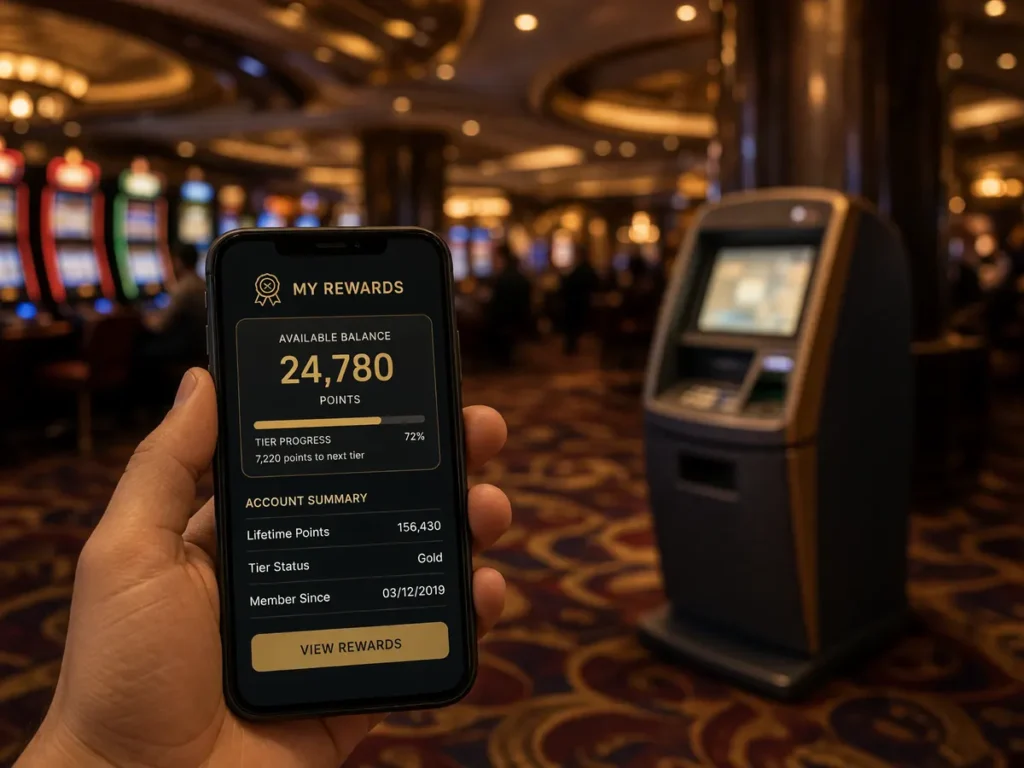
When did you last walk across a casino floor to check a points balance?
Casino loyalty technology is moving off stationary hardware and onto the device the player already has in their pocket, so that promotions, balances and redemptions travel with the guest instead of waiting at a fixed point on the floor. CasinoTrac’s KioskTrac is a useful case study for that shift, because the product has been in market long enough to show the whole arc. According to a CDC Gaming report on the company, chief executive and chief financial officer Randy Gilbert put it bluntly: “KioskTrac is no longer just about being a kiosk.”
The popular read on this is that casinos are going mobile because players prefer phones to touchscreens bolted to a wall. That read is correct, and it is correct for a reason most summaries skip. Convenience is the symptom. The real change is where the player account lives, and what can move in and out of it without anyone standing in a queue.
What KioskTrac was, and what CasinoTrac changed
The original self-service model
KioskTrac launched in 1997 as a self-service players club kiosk. Per the CDC Gaming report, it started as “a way for players to check balances and access offers,” and over the following years it grew into a platform handling promotions, rewards, contests, drawings, premium games and personalised marketing across the property.
That model worked, and its limitation was structural rather than technical. A kiosk is a destination. The player has to decide to walk to it, queue behind someone redeeming a drawing entry, and interact on the operator’s terms. Every offer the marketing team builds is gated behind that walk. If the guest never makes the trip, the offer may as well not exist, and the operator learns nothing except that an unredeemed coupon expired.
What the update adds
The reported evolution runs through integration with CasinoTrac, PlayerLINQ and the KTMobile app. Gilbert describes the result as “a connected engagement experience that spans kiosks, gaming devices, loyalty programs, and mobile technology.” KTMobile is a customised mobile rewards application that, in the report’s framing, extends the kiosk experience into the player’s hand and removes the need for engagement to begin and end at the kiosk.
The part that matters more than the app itself is underneath it. KTMobile uses CasinoTrac’s patented digital currency transfer solution to support cashless functionality across the property, with promotional and cash credits moving from the player’s account to slot machines, table games, restaurants and other points of sale through a digital player card. CasinoTrac demonstrated this connected version at G2E 2026, according to the same report.
Read that sequence again. The app is the visible layer. The transfer rail is the product.
Why player tracking systems are going mobile
Player tracking systems are moving to mobile because the loyalty account, not the kiosk, is the thing operators actually want to reach, and a phone reaches it from anywhere on or off the property. Carded play through a physical or digital player card already feeds a CRM with theoretical win, time on device and game preference. The phone changes what can be done with that data while the player is still sitting down.
In practice, “player-following” engagement means a personalised offer can land in an app while the session is live, a free-play credit can be pushed to a machine without a redemption trip, and a geofenced message can fire when a guest arrives on property rather than three days later in an email. Gilbert’s stated operator benefit is that it “reduces friction, increases engagement opportunities, and strengthens long-term player relationships,” and that the product becomes an ongoing relationship rather than a destination on the floor.
| Dimension | Kiosk-era loyalty | Mobile-era loyalty |
|---|---|---|
| Where redemption happens | At a fixed terminal | At the device, table, POS or in-app |
| When the operator makes contact | When the guest walks over | During the session, and off property |
| Offer timing | Batched, scheduled | Real time, triggered |
| Main friction point | Queue and walking distance | App download and opt-in |
How to judge a mobile loyalty claim, in order
Most “mobile loyalty” announcements describe an interface. A handful describe plumbing. These questions, asked in this sequence, separate them quickly.
- Can a reward be redeemed in full from the phone, or does redemption still end at a kiosk or cage window?
- Does value move between the player account and the slot machine, table and restaurant POS, or only between the account and one of them?
- Is the mobile app reading the same player record as the floor system in real time, or syncing on a delay?
- Does the offer engine fire on live session behaviour, or on last night’s batch?
- What happens to an uncarded or app-less guest, and does the programme still function for them?
Get question one wrong and you have bought a balance viewer. That is the cost of mistaking the interface for the product: an app that shows a guest exactly how many points they have, then asks them to walk to the kiosk anyway. The queue does not shorten, the offer still expires unredeemed, and the operator has added a support channel without removing a single step.
What it signals for casino loyalty programs generally
The land-based side is converging on patterns that online loyalty systems settled years ago. Tier progress visible at any moment, rewards credited instantly rather than claimed, offers tuned to recent behaviour, and a single account identity across every touchpoint. Omnichannel player engagement is the label; the practical effect is that a casino’s loyalty programme starts behaving like a wallet with a marketing layer on top.
Cashless capability is what makes it stick. Once promotional and cash credits can move to any point of sale, the loyalty balance stops being a coupon book and becomes spendable value, which is a materially different relationship with the guest. It also explains why operators are spending on this now rather than in 2015. The player card and the payment rail have merged, and nobody wants to run those as two systems.
The trade-offs worth stating plainly
Real-time tracking of where a guest is and what they are playing is surveillance with a rewards programme attached, and it should be described honestly. Consent and opt-in are not formalities: a player who downloads a loyalty app is agreeing to location and behavioural data collection, and jurisdictions differ in what disclosure they require. Data handling obligations scale with the volume collected.
Cost is the second constraint. Mobile layers sit on top of floor systems, cashless infrastructure and CRM, and the integration work tends to exceed the licence fee. Smaller properties often get the app and not the rail, which lands them back at question one above.
Third, the same personalisation machinery that times an offer well can also time it badly. Any operator pushing live offers to a session in progress should be pairing that capability with deposit, loss and session limits, self-exclusion that actually blocks app messaging, and reality checks. Gambling carries a built-in house edge, and engagement tooling does not change that arithmetic for the player, only how often they are invited to test it.
Where this is still unsettled
The near-term direction is predictable: kiosk and mobile converging on identical functionality, more offer logic firing on live play, and cashless coverage extending to every point of sale rather than the slot floor alone. The CasinoTrac arc, from a 1997 balance-checking terminal to a connected platform demonstrated at G2E 2026, maps that path tidily.
What is not settled is adoption. A player-following platform only follows players who install the app and leave notifications on, and the industry has published very little about how many actually do. Until that number is visible, the kiosk stays on the floor as the fallback for everyone who never opted in, which is the quiet reason it has not disappeared yet.