
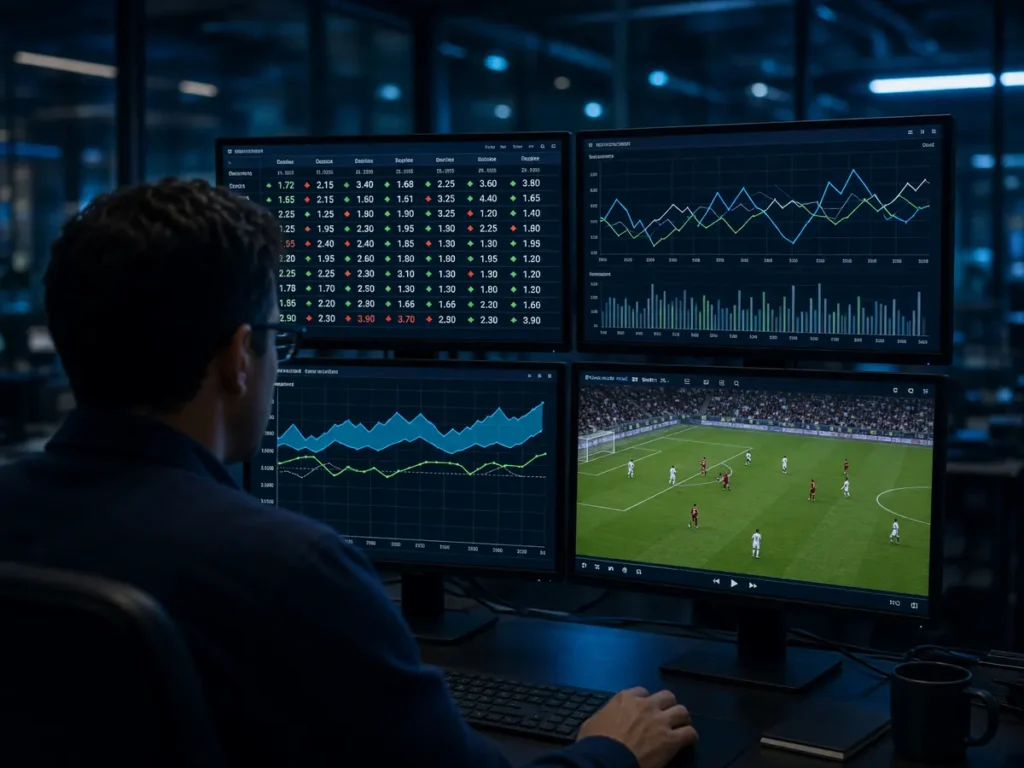
The price that was 2.10 at breakfast is 1.85 by lunch, and nobody on the desk has watched a single minute of the match. That is the part most bettors misread. Sports betting odds are set by trading teams who turn a probability estimate into a price, build a margin into it, then move that price as money and news arrive. Odds are not a forecast of what will happen. They are the price of risk, adjusted in real time by people whose job is to protect a book, and the demand for those people is rising: Pythia Sports, which supplies horse and greyhound racing pricing, trading and risk management services, has appointed Ben Hutton as its Head of Trading after two decades leading international racing at Entain and the businesses that became it.
Hutton’s remit at Pythia, as the company describes it, covers trading margins, how the racing product is presented to customers, and the tools the trading team uses. Read that list again, because it is a neat summary of what a trading desk controls: the edge, the shop window, and the machinery. Nothing in there is about predicting winners.
What a sports trading desk actually does
A sports trading desk is the team that prices betting markets, monitors how much money is riding on each outcome, and changes prices to keep the operator’s exposure inside agreed limits. It runs from the moment a market opens, through the pre-match period, and into the match itself.
The day has a shape. Markets get compiled and loaded. Opening prices go live, usually tighter limits at first because early money is the most informed money. Liability reports are watched: if one outcome has taken ten times the stake of the alternatives, the desk either shortens that price, lengthens the others, or both. News lands and prices get repriced or suspended. In racing, where Pythia operates, the same cycle compresses into minutes between races rather than days between fixtures.
Odds compilers, traders and the risk side
The roles overlap more than the job titles suggest, but they split roughly like this:
- Odds compilers build the opening prices, feeding statistical models with historical results, form, lineups, pace and venue data, then applying judgement where the model has thin evidence.
- Traders manage the market once it is live, moving prices in response to stakes taken, competitor prices and incoming news, and suspending markets when something happens faster than they can reprice.
- Risk managers set the rules the traders work inside: maximum liability per market, stake limits, which customers get full limits and which get cut back.
- Quantitative analysts build and test the models, and increasingly the automation layer. Hutton has worked on AI-based trading tools and models, an interest Pythia says he brings into the new role, which tells you where the effort is going.
How sports betting odds are set in the first place
Odds start as a probability estimate and end as a price with a margin inside it. A model produces a percentage chance for each outcome, that percentage is converted into decimal odds, and then every price in the market is shaved slightly so the book’s implied probabilities add up to more than 100%.
From probability to price
The conversion is simple arithmetic. Fair decimal odds are 1 divided by the probability. A 50% chance is 1 ÷ 0.50 = 2.00. A 25% chance is 4.00. Run it backwards and you get implied probability: 1 ÷ decimal odds. A price of 2.50 implies a 40% chance.
Here is an illustrative two-way market, not any operator’s real pricing, using round numbers to show where the money goes.
| Outcome | Model probability | Fair odds | Priced odds | Implied probability of priced odds |
|---|---|---|---|---|
| Team A | 50% | 2.00 | 1.91 | 52.4% |
| Team B | 50% | 2.00 | 1.91 | 52.4% |
| Book total | 100% | — | — | 104.7% |
Where the bookmaker’s margin sits
That extra 4.7% is the overround, also called the vig or margin, and it is the entire gap between what the number advertises and what the number is worth. A price of 1.91 looks like “a coin flip, minus a bit”. It is a coin flip minus roughly 4.5% of your stake in expectation, every time, forever. On a balanced book across that market the operator keeps about 4.5p of every pound staked regardless of who wins. Nothing about the result changes it.
This is the house edge of sports betting, and it is the honest reason bookmakers are businesses rather than charities. Margins vary: deep, liquid markets like major football match odds are usually priced tighter, while obscure leagues and novelty props carry fatter margins because the desk’s own estimate is less certain and it needs more cushion.
Why the line moves before anyone kicks off
Pre-match odds move for four main reasons: confirmed team news, conditions, one-sided betting volume, and money from customers the desk believes are well informed.
News is the obvious one. A starting goalkeeper ruled out, a non-runner in a race, rain forecast at a ground where it swings the ball. The model gets new inputs and spits out a new probability, and the price follows.
Volume is less obvious and more interesting. If a market takes heavy stakes on one side, the desk shortens that price to discourage more of it and lengthens the other to attract balance. Nothing has changed about the teams. The operator’s exposure has changed, and the price is a lever for exposure.
Then there is sharp money: stakes from accounts with a record of beating closing prices. When a book takes a bet it respects, it may move its line further than the stake alone justifies, and when several books see the same thing and move together within minutes, that is a steam move. Bettors who then compare their bet price to the final price before kickoff are measuring closing line value, the industry’s rough proxy for whether a bet was priced well.
What a steam move is not is evidence of a fixed result. A shortening price means the desk has revised its risk, usually because of information it rates. Genuine integrity concerns exist and are handled through monitoring and reporting, not through odds drift, and the rules around them are tightening in several markets. Confusing risk management with a leak is how people talk themselves into bets they would not otherwise place.
Live odds compiling: pricing a match that is already happening
In-play trading differs from pre-match in one word: speed. Live odds compiling is done by automated models that reprice markets every few seconds off a data feed, with human traders supervising, setting parameters, and stepping in when something happens that the model handles badly.
A red card, an injury to a key player, a weather delay, a sudden collapse in one team’s structure. Models update on events, but they do not understand context, and the standard response to ambiguity is to suspend the market rather than guess. That brief freeze you hit when a goal is disallowed is the desk deciding what the price should be with a human in the loop.
Live markets also carry wider margins than pre-match in many sports, because the desk is pricing under uncertainty with seconds to think and a latency risk it cannot fully remove. That is the trade-off for being able to bet on a match while watching it.
Why trading talent is suddenly worth paying for
In-play volume is where a lot of modern betting turnover sits, and pricing it well is a margin and a competitive position at the same time. Price too tight and you lose money to informed bettors; price too wide and customers notice and go elsewhere. Senior hires like Pythia’s appointment of Hutton, bringing two decades of bookmaker-side racing experience into a supplier, are the industry buying that judgement rather than building it slowly. Pythia’s MD and CTO Adrien Tillier framed the hire around exactly that: someone who understands the day-to-day demands of running a racing product and what operators need from their suppliers.
It also says something about who owns the pricing. Plenty of operators no longer compile their own odds for every sport; they buy pricing and risk services and differentiate on the product around them. If you have ever wondered why two different sites show the identical price on an obscure race, that is often why.
What to do with this, as the person placing the bet
Three things follow, and none of them is a system.
First, stop reading odds as truth. They are a desk’s estimate plus a margin plus whatever exposure management it is doing that morning. The estimate is usually good, which is the point, but it is still an estimate wearing a price tag.
Second, compare prices before you stake. Line shopping, checking the same market across licensed books, is the only edge available to an ordinary bettor that requires no prediction skill at all. The 4.7% overround in that worked example is not a constant; on the same market one book may sit at 4% and another at 7%, and over a season that difference is larger than most people’s actual selection skill. If you are curious how markets without a bookmaker margin behave differently, the mechanics of prediction markets versus sportsbook odds are worth understanding as a contrast.
Third, accept what you cannot see. When a price moves against you, you do not know whether it was team news, a single large stake, or a competitor’s move being copied. The desk knows. You do not, and no amount of chart-watching fixes that asymmetry.
Which leaves the one decision that is actually yours: what you stake and how often. The margin is built in, the desk is better resourced than you, and the long-run arithmetic does not bend. Bet money you are content to lose, use the deposit and loss limits your operator offers, and treat a price of 1.91 as what it is rather than what it looks like.