

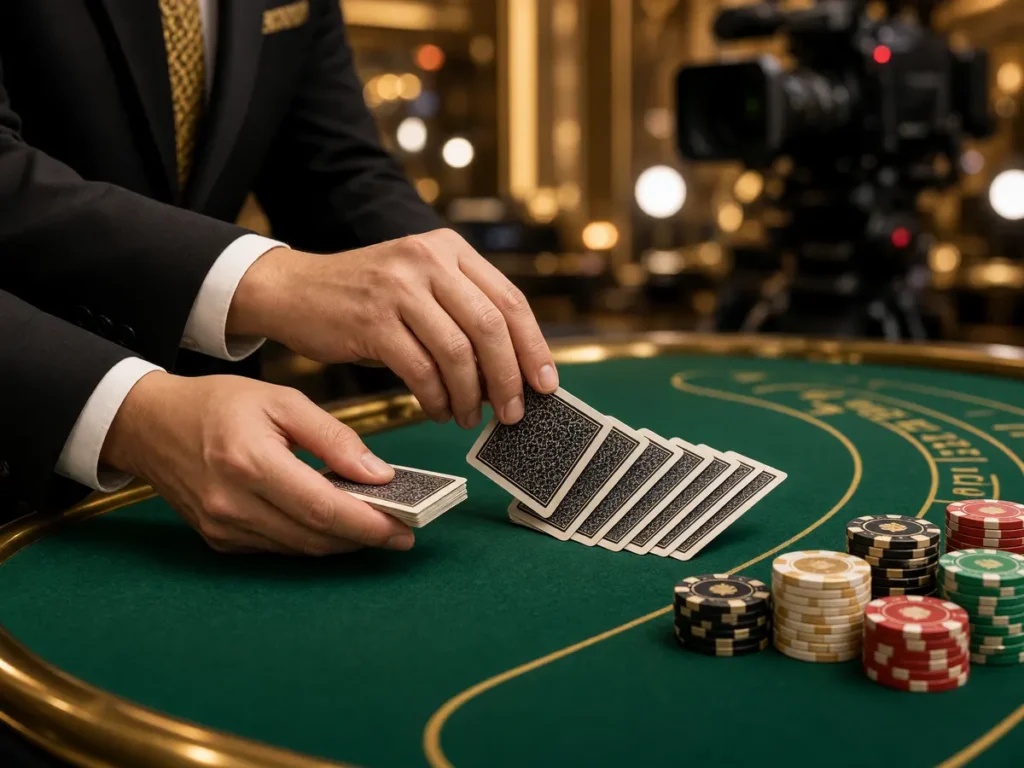
Does a real person dealing the cards make a live casino game fairer than a random number generator? Not in the way most players assume. Live casino dealer training governs how accurately and consistently a game is run: the shuffle, the cut, the payout, the call. It does not touch the house edge, and no amount of croupier skill will move it. Understanding that line is the difference between trusting a table for the right reasons and trusting it for the wrong ones.
The reason this is worth unpacking now: GGRAsia reported that MGM Osaka has endorsed a casino dealer course ahead of the integrated resort’s opening. It is a small procurement story on its face. It is also a clean illustration of where fairness in live games actually comes from, and where players keep looking for it by mistake.
What MGM Osaka’s dealer course endorsement actually tells you
MGM Osaka has put its name behind a casino dealer training course in advance of the resort opening, according to GGRAsia’s report. That is the confirmed fact, and it is worth resisting the temptation to embellish it. The report does not amount to a published curriculum, a pass rate or a guarantee that every dealer on the floor will have come through that specific programme. For the exact syllabus, hours and assessment standards, the operator’s own announcements and Japan’s regulator are the sources to check, not a news summary.
Why an operator builds a dealer pipeline years before the doors open
Japan has no existing commercial casino workforce. Macau and Nevada can hire croupiers who already know how to handle an eight-deck baccarat shoe under camera; Osaka cannot, because the country has never licensed a casino before. A dealer who can run a table cleanly at commercial pace takes months of drilling, not days, and an integrated resort of MGM Osaka’s scale needs them in the hundreds. Endorsing a course now is the same kind of lead-time planning as ordering the gaming tables.
There is a second motive, and it is reputational. Japan’s integrated resort framework was politically contested. A project that opens with visibly unpolished dealing invites exactly the scrutiny the industry there least wants.
Inside a dealer certification program
A professional dealer certification program trains procedure, not luck. Across established markets the content is broadly consistent, because the failure modes are consistent. Expect a course to cover:
- Card handling protocol: shuffling, cutting, burning, dealing from a shoe, and presenting cards so the camera and the pit both see what happened.
- Chip mechanics: cutting, sizing into, splashing avoidance, and keeping the layout readable at a glance.
- Game procedure for each game dealt, including the order of operations that makes a hand auditable after the fact.
- Payout accuracy and speed, usually drilled to the point where common payouts are recalled rather than calculated.
- Anti-cheating measures: recognising past posting, capping, card marking, dealer-player collusion signals, and knowing the escalation path to the floor supervisor.
- Customer-facing conduct: announcing the game state clearly, handling disputes without adjudicating them, and the responsible gambling and anti-money-laundering obligations that come with the role.
Training alone is not certification. In most regulated jurisdictions the licence or registration that lets a person deal for money is issued or approved by the regulator after a background check, and the training provider only prepares candidates for it. Treat any course marketed as a “certification” without naming the regulator behind it with scepticism.
The number on the table and the term that qualifies it
Here is the misreading that costs players money: believing that a well-run live table is a better-value table. Procedural integrity and mathematical edge are separate things. A flawlessly dealt game of live roulette still carries the same 2.70% house edge on a single-zero wheel as a sloppy one. The dealer’s competence changes the experience, the speed and the error rate. It does not change the arithmetic.
The cost of confusing the two shows up in side bets and in game selection. Players who feel reassured by a professional stream often accept whatever is on the layout, and the layout is where the expensive bets live. The advertised headline figure for a live table is almost always the best case, and the qualifying condition sits in small print or in the rules panel nobody opens.
| Live table bet | Typical house edge | The term that qualifies it |
|---|---|---|
| Blackjack, main hand | Around 0.5% | Only with correct basic strategy for that exact rule set; deviations raise it substantially |
| Baccarat, banker | 1.06% | After the standard 5% commission on winning banker bets |
| Baccarat, tie | Around 14.4% | At 8:1 on an eight-deck shoe, the common live configuration |
| Roulette, any bet | 2.70% | Single zero only; a double-zero wheel roughly doubles it |
Read the blackjack row again. “Around 0.5%” is quoted constantly, and it describes a player who never misplays a hand under one specific set of rules. Change the dealer’s action on soft 17, remove doubling after split, pay blackjack at 6:5 instead of 3:2, and the real figure moves against you while the marketing number stays put. That gap has nothing to do with how good the croupier is.
Where dealer skill protects you, and where it cannot
Dealer training reduces the chance that a hand is run wrongly, which is a genuine integrity contribution, not a guarantee of fairness. Fewer misdeals, fewer mispays, fewer unclear calls that have to be resolved from video afterwards. Consistent routine also narrows the openings an organised cheat can work with, because irregular procedure is what collusion exploits.
What training cannot do is replace licensing, supervision and auditing. A trained dealer working for an unlicensed operator with no independent oversight protects nobody. Fairness in live casino games is layered: the regulator licenses the operator and vets personnel, the pit or studio supervisor watches the table, the cameras provide a reviewable record, and the trained dealer executes the procedure the other layers depend on. Remove any layer and the rest weakens.
Dealer skill versus RNG: how each earns trust
RNG table games and live dealer games are audited in completely different places. In an RNG game, the outcome comes from a certified random number generator, and trust rests on laboratory testing of the algorithm plus periodic RTP verification by an independent test house. There is no human in the loop to err, and no human to watch.
In a live dealer game, randomness comes from physical cards, a physical wheel and a human hand, so the assurance moves to process: licensed staff, documented procedure, supervision, and recorded video that can be reviewed when a result is challenged. Neither model is inherently safer. They fail differently. An RNG game fails if the software or its certification is compromised; a live game fails if procedure and supervision slip. If you want the longer comparison of how game-level checks work in practice, the same logic applies when you check a new slot provider’s RTP and licensing”>vet any unfamiliar provider.
How casino dealer standards are set across major markets
In established markets, dealer standards are enforced through employee licensing or registration tied to the operator’s own licence rather than through a single global certificate. Nevada requires gaming employees to be registered with the state’s regulator before working on the floor. Macau’s gaming law reserves croupier roles for local residents and sits under the territory’s gaming inspection authority. Several European regulators place the duty on the licensed operator to train, vet and supervise staff, then audit the operator’s compliance rather than licensing each dealer directly.
The practical point for players: there is no portable, internationally recognised “dealer certificate” that travels between jurisdictions. Any claim that there is should be checked against the named regulator’s published requirements.
Japan’s integrated resort framework is the newest entrant to this picture. It establishes national-level casino regulation with a dedicated commission responsible for licensing casino business operators and vetting people involved in casino operations, and the detailed personnel requirements are published by that commission rather than by the resorts. MGM Osaka’s course endorsement fits that structure: the operator builds the pipeline, the regulator sets the gate.
A practical check before you sit down at a live table
You cannot inspect a dealer’s training records. You can read the signals that tend to travel with a properly run operation. Work through these in order:
- Find the licence first. Check the operator’s licensing details in the site footer and verify the licence number on the regulator’s own register, not on the casino’s word.
- Open the game rules panel before betting. Note the deck count, the dealer’s rule on soft 17, the blackjack payout, and the exact odds on every side bet offered.
- Watch one full round before joining. A competent dealer announces the game state clearly, deals at a steady rhythm, and keeps the layout tidy enough that you can see where every chip sits.
- Look for the game provider and any independent testing seal on the studio, then check that the seal links somewhere real.
- Note how disputes are handled. A trained croupier calls the supervisor rather than settling a contested hand personally. That escalation is the procedure working, not a problem.
What the Osaka story leaves open
MGM Osaka’s dealer course is one data point in a wider professionalisation of live casino work, driven by new integrated resorts on one side and by the expansion of online live casino studios on the other. The land-based side of that trend is reasonably well documented, because employee licensing is public record. The online studio side is not. Studio staffing levels, training hours and turnover are rarely disclosed by providers, so players judging an online live table are mostly inferring quality from what the camera shows them. That is a real gap, and no public standard currently closes it.
So treat dealer training as one pillar of live casino integrity, sitting alongside licensing and independent auditing, and never as a substitute for either. Whatever table you choose, the house edge comes with it. Set a deposit or loss limit before you play, use the operator’s session tools, and read up on how gambling spending spikes around income dates”>the spending patterns worth watching in your own play. If gambling stops feeling like entertainment, the self-exclusion and cool-off tools on any licensed platform are there to be used.