

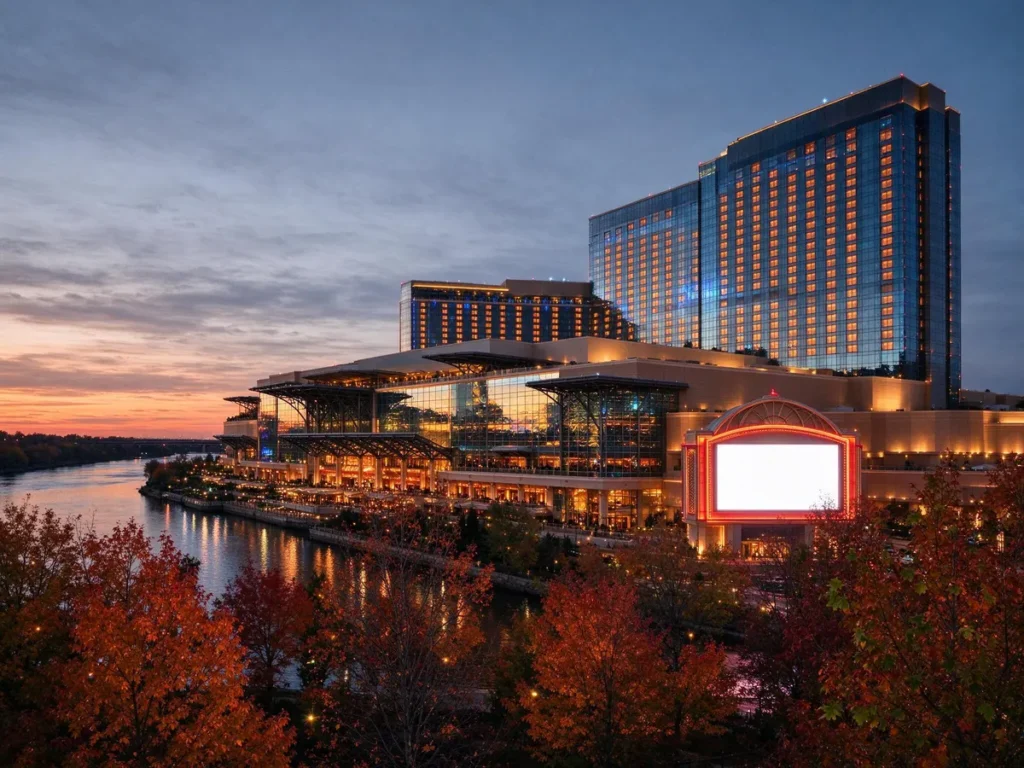
Three nights at the arena, and what the Mohegan Sun anniversary marked
Mohegan Sun closed its 30th anniversary weekend with DJ Cassidy’s Pass the Mic Live! at Mohegan Sun Arena, with Busta Rhymes, Fat Joe, Ja Rule, Jadakiss and Nelly on the bill. That Sunday show capped three nights of concerts, a red-carpet event and a birthday party at the Uncasville, Connecticut resort, which opened in 1996 and is owned and operated by the Mohegan Tribe of Connecticut, a federally recognised sovereign tribal nation.
John Mayer opened the run on Friday at the arena. Saturday split across two rooms: Lainey Wilson on the arena stage, Flo Rida playing a free show at the Wolf Den. Afterwards Wilson, 50 Cent and Flo Rida walked a red carpet alongside Bobby Flay, Antoni Porowski and Jadakiss, with a contingent of Bravo television personalities including Teresa Giudice, Dorinda Medley, Ramona Singer, Sonja Morgan, Erin Lichy, Sai De Silva, Kelsey Swanson and Kyle Cooke. Cooke took the DJ booth at the birthday party before 50 Cent ran through his hits.
Read as a listings item, that is a good weekend of bookings. Read as a business document, it is a fairly precise statement of what Mohegan Sun has become over three decades: a gaming floor that pays for an entertainment operation large enough to book arena headliners, and an entertainment operation that keeps the gaming floor busy. The interesting question is whether that model carries over to the part of the industry the resort entered much later.
From a 1994 federal recognition to a Connecticut gaming landmark
Mohegan Sun exists because the Mohegan Tribe secured federal recognition in 1994, negotiated a gaming compact with the state of Connecticut, and opened its casino on a former industrial site along the Thames River in 1996. The property arrived second into a market that Foxwoods, run by the neighbouring Mashantucket Pequot Tribal Nation, had already proved was enormous. Southeastern Connecticut, within a few hours’ drive of New York and Boston, turned out to support two of the largest casinos in the United States at a time when commercial gaming was still mostly confined to Nevada and Atlantic City.
The first version of the resort was a single casino floor, later branded Casino of the Earth, with the Sky Tower hotel opening alongside it in 1996. The transformation came at the start of the 2000s with the Casino of the Sky expansion, completed in 2002, which added a second gaming floor, the arena and retail space. That build is the hinge in the whole story. Before it, Mohegan Sun was a very large gaming hall with restaurants attached. After it, it was a resort that happened to have two casino floors.
Growth since has been less about square footage in Uncasville and more about putting the Mohegan name on properties elsewhere. The parent company now holds or manages gaming assets well outside Connecticut.
| Property | Location | Relationship |
|---|---|---|
| Mohegan Sun | Uncasville, Connecticut | Flagship, owned and operated, opened 1996 |
| Mohegan Pennsylvania | Wilkes-Barre area, Pennsylvania | Owned and operated (formerly Mohegan Sun Pocono) |
| Fallsview Casino Resort and Casino Niagara | Niagara Falls, Ontario | Operated by Mohegan since 2019 as service provider under contract with the Ontario Lottery and Gaming Corporation, which owns the facilities |
| Casino at Virgin Hotels Las Vegas | Las Vegas, Nevada | Formerly managed by Mohegan; casino operations moved in-house, with the arrangement originally planned to end by the end of 2024 and Mohegan exiting the property in early 2025 |
| Inspire Entertainment Resort | Incheon, South Korea | Integrated resort, opened 2024 |
The arena is not a sideline, it is half the business
Mohegan Sun Arena seats roughly 10,000 and is the reason a Connecticut casino can book John Mayer and a hip-hop revue on consecutive nights. It has hosted touring music, boxing, and since 2003 the WNBA’s Connecticut Sun, which the tribe acquired and relocated to the property. Below it sits the Wolf Den, a free-admission stage on the casino floor where Flo Rida played during the anniversary weekend, and which has run no-ticket shows for decades.
The pairing matters more than it looks. An arena gives a regional casino something the gaming floor alone cannot: a reason for people who do not particularly want to gamble to drive two hours and then walk past the tables anyway. A free Wolf Den set does the same job at smaller scale and lower cost. Entertainment stopped being an amenity at Mohegan Sun some time in the early 2000s and became a second product line with its own revenue, its own audience and its own booking calendar.
The anniversary programming was built the same way. Three ticketed arena nights, one free show, one red carpet, one party. It covers country, pop, hip-hop and reality television, because the property’s audience is not one audience.
What earns Mohegan Sun a place among iconic casino brands
Scale and longevity, mostly, rather than any single superlative. Mohegan Sun combines two connected casino floors, a hotel tower that is among the taller buildings in Connecticut, a shopping concourse, a 10,000-seat arena and a sizeable restaurant and bar roster on one site, and it has run that mix continuously for 30 years under the same tribal ownership.
Placing it against other recognised US casino brands is a question of category, not ranking. The Las Vegas Strip properties are leisure destinations first, built around air travel and conventions. Atlantic City’s boardwalk houses are a regional market in long decline. Mohegan Sun, with Foxwoods, defines a third category: the drive-to regional megaresort serving a dense metropolitan catchment, operated by a sovereign tribal nation rather than a listed corporation. Tribal gaming in Connecticut and elsewhere is governed under the federal Indian Gaming Regulatory Act and state compacts, which is why these properties answer to a different regulatory structure than their commercial peers.
Anyone writing about the property’s awards or visitor numbers should source them directly. Resorts of this size collect trade and travel accolades continuously, and the counts circulated in marketing material are not independently verifiable.
Does Mohegan Sun have an online casino?
Yes, in the sense that the Mohegan Tribe holds online gaming and sports betting rights in Connecticut, and no, in the sense that the product customers actually open on their phone does not carry the Mohegan Sun name. Connecticut legalised online casino gaming and sports wagering in 2021 under agreements with its two tribes, each permitted a limited online presence. Mohegan’s partner is FanDuel, which operates the retail sportsbook at the resort as well as online casino and sportsbook products in the state under the tribe’s authority.
This is where the usual story about heritage brands converting into digital brands stops working. The received wisdom is that a 30-year land-based name is a head start online: trusted, recognised, with a database of players already attached. In Connecticut the economics ran the other way. The tribe retained the licence and the revenue share and handed the customer-facing brand to a national operator with the technology stack and the marketing budget already built. Mohegan Sun’s three decades of brand equity bought it a seat at the table, not a logo on the app.
The company does run a digital arm, Mohegan Digital, and Mohegan-branded online products have appeared in more than one jurisdiction. Beyond that I would not state specifics with confidence. Online brand footprints shift as partnerships are signed and dropped, and the only authoritative record of which operators and skins are live in a given state is the regulator’s own licensee list, such as the Connecticut Department of Consumer Protection’s or New Jersey’s Division of Gaming Enforcement. Anything else, including the state of play six months from now, is guesswork dressed up as reporting.
Worth noting for anyone reading this as a player rather than an industry watcher: a long-established land-based name behind an online product says something about licensing and accountability, nothing about the mathematics. The house edge on every game is the same whoever owns the building. Deposit limits, session limits and self-exclusion tools exist on both sides of the business, and they are the only part of a casino visit that genuinely rewards planning.
Why a 30-year mark registers with people who follow casino brands
Thirty years is long enough in this industry to have been a competitive threat, a market leader, a regional incumbent and an acquirer, and Mohegan Sun has been all four. The properties that survive that long are the ones that keep finding a second product when the first one matures, which in this case meant an arena, a hotel tower, a WNBA franchise, casino operations in Ontario, Nevada and South Korea, and eventually a licensing arrangement with a betting app.
What the anniversary weekend does not settle is the part that still looks unresolved. A resort can book 50 Cent, fill 10,000 seats and run a free show downstairs, and none of that establishes whether the name on the marquee can carry weight in a market where the customer never drives to Uncasville at all. Three decades proved the first model. The second is still being tested, and the answer will show up in regulator filings long before it shows up in a concert lineup.
If gambling stops being entertainment, operator and state-run support tools, including deposit limits and self-exclusion, are available to anyone who asks.