

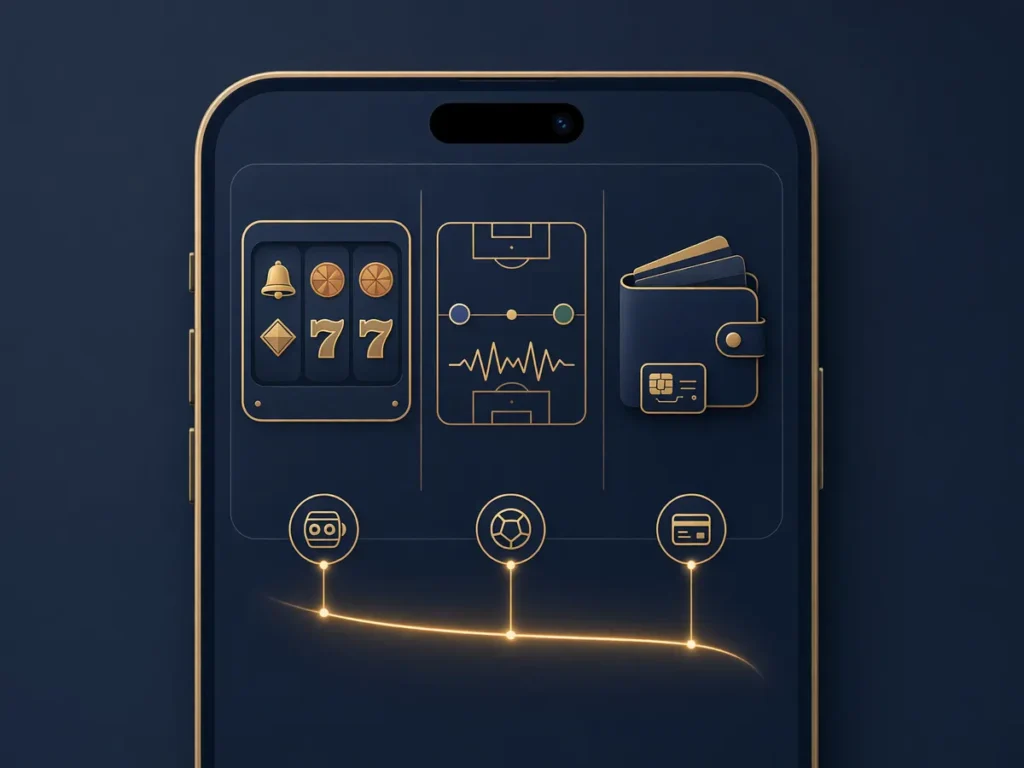
You’re on a betting app with a cricket bet running, and a tab appears where “Promotions” used to sit: Live Casino. Same login, same balance, no new download. Nothing about your account changed on your side, and yet the app now does something it didn’t do last month. That tab is the visible end of a multi-vertical iGaming partnership, a deal signed months earlier between companies you’ve never heard of, and it changes two practical things for you: where your money can go, and which set of terms applies once it goes there.
The deal prompting this explainer is ICONIC21’s partnership with the platform provider Advabet, also known as Adwa. It’s a useful example precisely because the word “multi-vertical” in its headline does not mean what most players assume it means.
What a multi-vertical iGaming partnership actually is
A multi-vertical iGaming partnership is a commercial deal covering more than one product category at once instead of a single one. Depending on who signed it, those categories can be content types, such as slots, live casino and virtual games, or business lines, such as casino, sportsbook and payments. One contract, several products.
Single-vertical operators run one thing. A casino-only brand sells games; a sportsbook-only brand sells markets on matches. Multi-vertical setups put several of those under one platform, one account and usually one wallet. Most of the growth in online gambling over the past decade has gone in that direction, because the supplier layer underneath makes it cheap to add a vertical you didn’t build yourself.
The ICONIC21–Advabet deal, and the word that trips people up
ICONIC21 agreed to distribute its gaming portfolio across Advabet’s operator network and managed brands. Per the announcement, the agreement covers all the major gaming verticals in ICONIC21’s catalogue, with an initial rollout across Advabet’s own B2C brands before extending into its wider B2B ecosystem. The content named includes slots, virtual games and live casino products, among them titles from Gravity Games and the virtual game iDealer Blackjack. Advabet’s own specialism is tailored online casino solutions, platform technology, gamification tools and integrations, and ICONIC21’s commercial chief described the appeal as that flexibility and tailored approach.
Read it again and you’ll notice what isn’t there. No sportsbook. No payments rail. The “verticals” in this deal are content categories inside one supplier’s portfolio, not separate business lines of a gambling company. It’s a distribution agreement, close in kind to the way casino game aggregation platforms distribute studio content to operators.
That distinction is the condition almost nobody checks. Two headlines can both say “multi-vertical partnership” and describe completely different things.
| Sense of “vertical” | What it covers | Who announces it | What you actually notice |
|---|---|---|---|
| Content verticals | Slots, live casino, virtual games, crash titles | Game studios and platform providers | New games appearing in the existing casino lobby |
| Business verticals | Casino, sportsbook, payments, poker | Operators and B2C brands | A new product tab, a shared wallet, new terms pages |
The cost of mixing them up is small but real: you read a supplier press release as a promise of a sportsbook that was never part of the deal, or you assume a genuinely bundled platform is only adding a few slots when it has in fact put a second regulated product behind your single login.
Why operators keep expanding into new verticals
The business case is retention, not generosity. A player who only bets on football has a dead week when the fixture list is thin; a player with a casino tab in the same app does not. Operators measure this as cross-sell, and the arithmetic favours them: acquiring a customer costs real money in marketing, so selling a second product to someone already verified and funded is far cheaper than finding a new person.
Underneath that sits one operating cost base. One platform contract, one KYC flow, one payments integration, one support team, one compliance function covering several products. Adding a vertical through a partnership rather than building it in-house turns a development project into a licensing fee. That’s the consolidation pattern running through the whole supply chain right now, and the ICONIC21 deal is one modest instance of it.
Be clear about who the efficiency serves. None of it changes a game’s return to player, the margin baked into a sportsbook’s prices, or the house edge on a roulette wheel. A slot with 96% RTP has a 4% house edge whether it sits in a casino-only app or next to an in-play football market. Bundling buys you convenience and selection. It does not buy you a better price.
What changes on your side of the screen
One account, one wallet
The most immediate effect of casino and sportsbook integration is a unified player account: a single registration, a single KYC verification, and usually a single wallet funding both products. You deposit once by UPI or card and can stake that balance on a match or a slot without transferring between sub-accounts.
It’s genuinely less friction. It’s also why a bundled platform needs more attention, not less: one balance means one pool of money with two very different ways of disappearing from it.
More bet types and more games, in the same place
You get breadth. Match winners, handicaps and in-play markets alongside slots, live dealer tables, and whatever Indian card formats the operator carries, such as Teen Patti or Andar Bahar. Content deals like ICONIC21’s are what fill that lobby, which is why game catalogues can grow by dozens of titles overnight without the operator announcing anything to you.
Breadth is not quality. A platform can list 3,000 games and still hold a thin selection of the ones you’d actually choose, and a sportsbook bolted on through a third-party feed can carry shallower markets and wider margins than a specialist book. Judge the products separately, because they were built separately.
How the integration works behind the tab
In most cases, the operator holds the front end and the relationship with you, while separate suppliers provide the casino content, the sportsbook feed and the payment processing. The platform provider stitches them together: one session, one wallet ledger, one set of player records. When you move from a bet slip to a live blackjack table, you’re crossing from one supplier’s product into another’s without leaving the operator’s shell.
That architecture explains most of the catches below. The brand is single. The rulebooks are not.
The catches worth checking before you deposit
Bonus terms are the first place bundling breaks down. A welcome offer advertised on the homepage often applies to one vertical only, and the terms that control it differ sharply by product: wagering requirements with game weighting of 100% on slots but far less on table games or sports bets, max bet caps while a bonus is active, max cashout limits, and a sticky bonus you can’t withdraw even after clearing it. A 30x requirement on a ₹1,000 bonus means ₹30,000 staked before withdrawal, and whether your football bet counts toward that at all is a line in the terms, not a given.
Second, your data and verification are shared across the whole account. One KYC submission covers casino and sports because it’s one operator entity holding the records. Convenient, and worth understanding for what it implies: your activity across both products sits in the same file, used for the same risk, bonus-abuse and affordability checks.
Third, licensing is per entity and sometimes per product, not per logo. A brand can hold authorisation for casino in one jurisdiction and run its sportsbook through a different licence, a different corporate entity, or none that covers you. Check the footer, check which regulator is named against which product, and treat a licence for one vertical as evidence about that vertical only. Studios chasing licensed, regulated markets rather than grey ones do it because the licence is the enforceable part.
And the part nobody puts in a press release: bundled access is bundled exposure. A single wallet shortens the distance between a lost bet and a spin meant to recover it, and the slot doesn’t know or care what happened in the match. Set deposit and loss limits before you need them, confirm they apply to the whole account rather than one product, and use the cool-off or self-exclusion tools if the pace stops feeling like yours.
A short check before you sign up to a bundled platform
- Identify the licence behind each product you intend to use, and the entity that holds it.
- Read the bonus terms per vertical: wagering multiple, game weighting, max bet, max cashout, and whether sports bets count at all.
- Confirm which payment methods work for withdrawals, not just deposits, and what the stated payout timeline is.
- Test whether deposit limits, loss limits and self-exclusion apply account-wide or only to the casino side.
- Compare the sportsbook’s prices on a market you know against a specialist book before assuming the bundle is competitive.
What these deals leave unsettled
Deals like ICONIC21’s with Advabet will keep arriving, and most of them will be announced in language written for trade buyers rather than for you. The open question is whether any of this consolidation reaches your side of the ledger as better value instead of only wider choice. So far the evidence points to convenience: more products, one login, the same mathematics. What you control is narrower and more useful. Before the bundle becomes your default, read the terms of each vertical as though they belonged to separate companies, because in contractual terms they usually do.