

One federal approval, one remand recommendation, no settled law
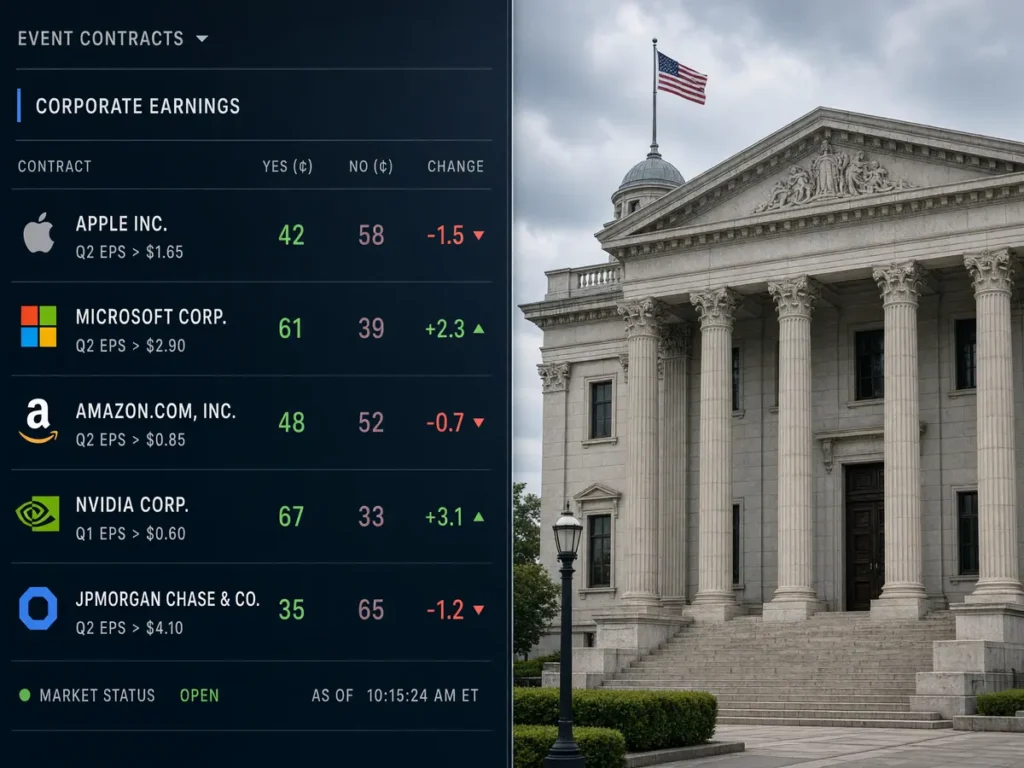
The contracts the SEC just cleared are tied to Apple’s iPhone sales, YouTube advertising revenue and Nvidia’s data centre revenue. Not elections. Not the Super Bowl. The Commission approved Cboe’s request to list binary options on corporate performance, with Robinhood expected to be the first broker to put them in front of retail investors. In the same news cycle, a federal magistrate judge in Kentucky recommended that state enforcement lawsuits against Kalshi and Polymarket be sent back to state court. Read together, the two developments show that prediction market regulation is still an open fight, not a resolved one.
There are two honest ways to read this. One says the SEC’s sign-off is the beginning of the end of the argument: once a national securities exchange lists event contracts and a mainstream broker distributes them, the “this is just gambling” framing loses its force. The other says the two stories barely touch, because the Kentucky dispute turns on state gambling statutes that a federal securities approval does nothing to displace. The first reading has real weight over a multi-year horizon. For anyone deciding today whether to fund an account or build a compliance plan, the second is the one that governs.
What Cboe can actually list, and what the approval does not cover
The SEC approved Cboe’s filing to list binary options referencing specific company results on a registered securities exchange. Instead of taking a position on where a share price goes, an investor takes a position on whether a stated corporate outcome occurs, such as a revenue figure for a named business line. Robinhood is expected to be the first broker to offer them to retail customers.
Notice how narrow that is next to the headline. It is an approval of a product, filed by an exchange, under securities rules, subject to the terms in the Commission’s order. It is not a finding that event contracts in general are lawful everywhere. It is not a ruling about sports markets, election markets, or the platforms currently being sued. And it says nothing about the two companies at the centre of the Kentucky actions, which are not SEC-registered securities exchanges at all. Anyone reading “SEC approves prediction contracts” as “prediction markets are now legal in the US” has collapsed a product approval into a jurisdictional verdict that no regulator has issued. For the exact scope and conditions, the Commission’s published order on the Cboe filing is the document that controls.
Kentucky: what a remand to state court actually does
A remand sends a case back to the court it came from. Kentucky brought enforcement actions against Kalshi and Polymarket; the defendants moved them into federal court, and a federal magistrate judge has now recommended returning them to state court. That recommendation is procedural. It decides where the dispute is heard, not who wins it.
Two qualifications matter. First, a magistrate judge’s recommendation is not a final order: a district judge reviews it before it takes effect, and the parties can object. Second, nothing about remand addresses the merits. The underlying question, whether these contracts amount to illegal gambling under Kentucky law, remains entirely undecided.
Venue is still not a neutral detail. Operators generally prefer federal court, where arguments about exclusive federal jurisdiction over designated contract markets land in front of judges who handle that framework daily. State regulators generally prefer their own courts, interpreting their own gambling statutes. A remand hands the first round to the regulator’s chosen forum. Readers should check the case names and the responsible Kentucky agency against the filings before quoting specifics; the reporting establishes the parties and the recommendation, not every procedural detail.
Why a federal clearance and a state gambling claim can both stand
Event contracts sit on two legal tracks at once, and the tracks have different gatekeepers. On the federal side, the SEC oversees securities exchanges such as Cboe, while the CFTC oversees derivatives and the designated contract markets that list event contracts. On the state side, gambling statutes define what counts as an unlawful wager within that state’s borders, and state regulators enforce them independently.
So a product can clear a federal agency’s listing standards and still be challenged as a wager under a state’s code. The bridge between the two is federal preemption: the argument that federally regulated derivatives trading displaces conflicting state gambling law. That argument is live, contested, and being litigated. Until a court of sufficient authority settles it, “approved by a federal agency” and “lawful in every state” are different claims, and only the first one has happened here.
The CFTC’s newest rulemaking has already entered the agency’s litigation in New York and prompted arguments in a fresh Underdog suit against Tennessee, which tells you how fast the jurisdictional question is moving between venues. A similar scrutiny gap already shows up in sports markets, where Kalshi’s draft contracts sit under a different rulebook from licensed sportsbooks offering comparable propositions.
Derivative or wager? The question courts keep deferring
Nobody has produced a national answer to whether Kalshi- and Polymarket-style event contracts are financial derivatives or bets. The contracts have genuine features of both: a binary payout on an uncertain future event, a market price that reads as an implied probability, hedging utility for some participants and pure speculation for others. Which feature a court treats as decisive has varied, and the question is being worked through state by state and agency by agency.
Practically, that means “is Kalshi legal in Kentucky” and “is Polymarket legal in the US” do not have clean yes-or-no answers right now. Access exists in many places, enforcement actions and litigation are running in others, and the position in any given state can change on a single ruling. That is not a dodge, it is the actual state of the law. The Cboe decision does not change it, because corporate-performance options on a securities exchange are a different product filed by a different kind of entity under a different statute.
What the ambiguity costs the person with money on the platform
Unsettled legal status transfers risk to the user, and that is the part the headlines bury. If a platform’s status flips in your state, availability can be withdrawn with little notice, open positions may need to be closed or settled on terms you did not choose, and the path for resolving a dispute depends on which regulator, if any, has authority over the account. Funds held with a CFTC-regulated venue sit under a different protective regime than funds with an offshore or unlicensed one, and users frequently cannot tell which they are dealing with from the marketing alone.
State action can also be abrupt. The crackdown on sweepstakes casinos and the operator exits that followed is a recent reminder of how quickly a contested model can be withdrawn from a market once a regulator moves. Treat “SEC approved” the way you would treat any licence claim: ask which entity holds it, for which product, in which jurisdiction. If participation is discretionary spending for you, size it accordingly, use the deposit and loss limits a platform offers, and do not treat an event contract as a safer bet because it happens to trade on a screen that looks like a brokerage.
The rulings worth watching next
The nearest decision point is in Kentucky, where a district judge must act on the magistrate’s recommendation before the enforcement suits proceed in state court on the gambling question itself. Beyond that, the CFTC’s rulemaking is now a factor in the New York litigation and in Tennessee, where the Underdog case is testing similar ground, and other states with active sports-wagering regimes have obvious incentives to file their own actions.
The trajectory points toward a jurisdictional showdown rather than a quiet settlement: federal agencies expanding the recognised universe of event-based products while individual states insist their gambling codes still apply inside their borders. One of those positions eventually has to yield, and nothing in the Cboe order tells you which.