
A prediction market is a venue where people buy and sell contracts tied to the outcome of a real-world event, and the price of each contract moves with what traders collectively think the odds are. That is the one-line version, and it is where most explainers stop. The complication is that a price is not the same thing as a probability, and a market with no bookmaker’s margin is not the same thing as a market with no cost.
The reason prediction markets explained in plain terms matter right now: Blockchain.com, a Dallas-based crypto platform, has filed applications with the Commodity Futures Trading Commission for the licences needed to run event contracts for U.S. customers. It is the latest crypto brokerage to go after a product that looks like sports betting from the outside and behaves like a derivatives exchange on the inside. Below, the mechanics: how a contract is priced and settled, how that differs from fixed odds and from a peer-to-peer exchange, and which of the popular claims about these markets hold up.
Event contracts: you are buying a claim, not placing a bet
An event contract is a binary instrument on a yes/no question that settles at $1 if the stated outcome happens and $0 if it does not. You are not asking a bookmaker to accept a wager at a price it has set. You are buying shares of a claim from another trader, and you can sell them again before the event resolves.
That last part is the real structural difference. A fixed-odds bet is locked the moment it is accepted. A contract position is an asset: if you buy “Team A wins” at 40¢ and the price climbs to 70¢ after a strong first half, you can sell at 70¢ and bank 30¢ a share without waiting to see who wins. You can also sell at 25¢ and take the loss early. Traders describe that as closing a position; bettors would call it cashing out, except here the price comes from the order book rather than from a sportsbook’s own cash-out formula.
What settlement actually looks like
At expiry the exchange resolves the question against its stated source, and every contract becomes worth either $1 or nothing. Buy 100 contracts at 62¢ and you have risked $62. If the outcome lands, you receive $100, a profit of $38. If it does not, the $62 is gone. The equivalent in betting language is decimal odds of roughly 1.61 (1 ÷ 0.62), so a bettor comparing venues can convert in either direction without much trouble.
Myth one: the contract price is the true probability
A contract trading at 62¢ implies a 62% chance, but “implied” is doing real work in that sentence. The price is what the marginal buyer and seller agreed on, which is an estimate shaped by whoever happened to be trading, how much capital they had, and how much they cared. In a deep market with sharp participants it is a good estimate. In a thin market on an obscure question it is whatever two people felt like at 3am.
What is genuinely different is the absence of a built-in margin on the pair of prices. Here is the comparison worth internalising:
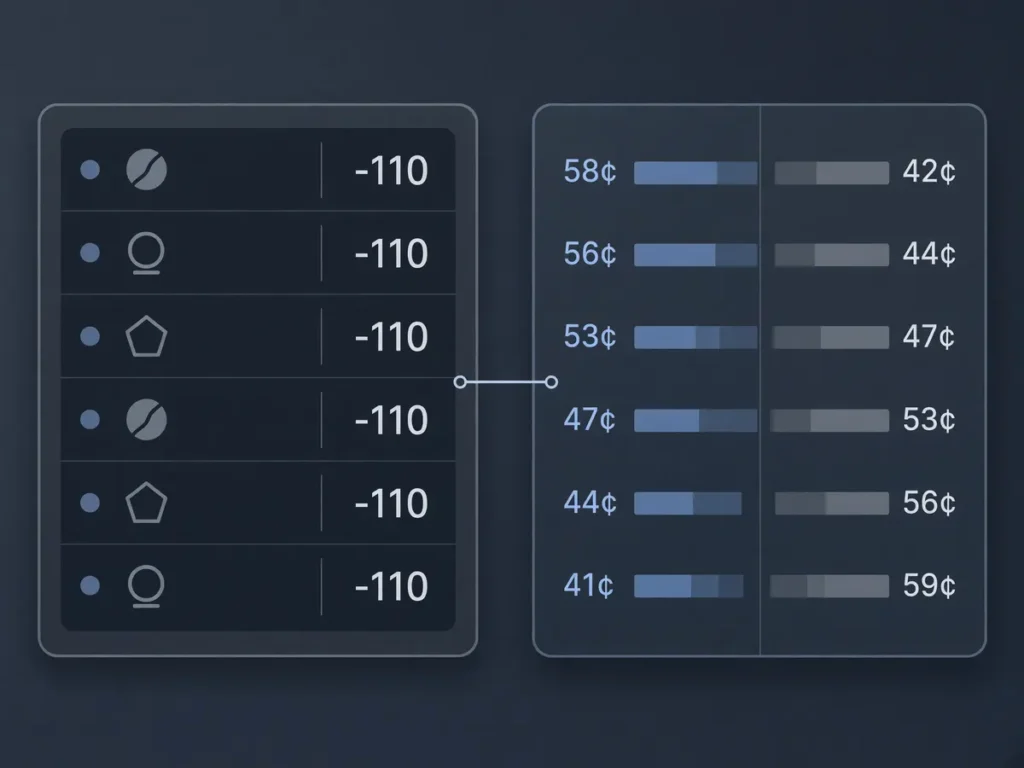
- A sportsbook posting -110 on both sides of a two-way market is quoting an implied probability of 52.38% per side. The two sides sum to 104.76%, and that extra 4.76% is the overround, the vig, the juice. On a balanced book it translates to a house edge of roughly 4.5% of total stakes.
- On a prediction market, “yes” at 62¢ and “no” at 38¢ sum to exactly 100¢. No overround is baked into the quote, because no operator is quoting it. Traders on both sides are.
That difference is real, and it is the strongest argument for the format. It is also where the second myth lives.
Myth two: no vig means no cost
You pay the spread instead. If the best offer on “yes” is 63¢ while the best bid sits at 61¢, then buying yes costs 63¢ and buying the opposite side costs 39¢, and those two sum to 102¢. The 2¢ is a transaction cost by another name, collected by whoever is making the market rather than by a bookmaker. On top of that most regulated venues charge trading or settlement fees, and a platform that custodies your funds has to be paid somehow.
So the honest framing is not “prediction markets are free and sportsbooks are expensive.” It is that the cost moves from a fixed, advertised margin to a variable, liquidity-dependent one. On a heavily traded NFL market the spread may be a penny wide and cheaper than any sportsbook line. On a niche question with three participants it can be worse than the juice you were trying to avoid. The cost is still there; you just have to look at the book to find it.
Where betting exchanges fit in
Exchanges such as Betfair already solved the peer-to-peer problem years ago, and the family resemblance is obvious: an order book, users on both sides, no bookmaker setting the line. The differences are in the accounting and the regulatory wrapper rather than the matching engine.
An exchange keeps the betting vocabulary. You back or lay at odds, your liability is calculated from the stake and the price, and the platform takes a commission on net winnings in a market rather than a margin on the price. A prediction market keeps the finance vocabulary. You hold a position worth between 0 and 100 cents, your maximum loss is what you paid, and the instrument is a contract that can be sold to a third party.
| Feature | Prediction market | Betting exchange | Sportsbook |
|---|---|---|---|
| Who sets the price | Traders, via an order book of bids and offers | Users backing and laying, via an order book | The operator’s traders and models |
| Where the cost sits | Bid-ask spread plus platform fees | Commission on net market winnings | Overround built into the odds |
| Who is on the other side | Another trader; the exchange clears the trade | Another user; the exchange holds stakes | The operator itself |
| Payout trigger | Settlement at $1 or $0 against the stated resolution source | Market settlement by the exchange’s rules | Bet graded and paid per the operator’s rules |
| Exit before the event | Sell the position at the market price | Lay off at current odds | Only if the operator offers cash-out |
Counterparty risk is worth a separate thought. With a sportsbook, the operator owes you; it is both your opponent and your custodian. With an exchange or a prediction market, another user is your opponent, but the venue still holds your money and still decides how the market settles. Swapping bookmaker risk for platform risk is a change of shape, not an elimination.
Why a crypto brokerage wants a DCM licence
Blockchain.com has applied for Futures Commission Merchant and Designated Contract Market registrations, the two permissions that let a firm both operate an event contract exchange and custody client funds for derivatives trades. FCM status is obtained through the National Futures Association; DCMs register with the CFTC and can serve retail as well as institutional traders, which is what makes the prediction market business possible at all.
The company is not starting from nothing. It already runs perpetual futures and event contracts for international clients, launched self-custodied prediction market products earlier in the year, and reports more than 95 million wallets across 44 million verified accounts in over 70 countries, with upwards of $1.1 trillion in crypto transactions processed. It is also reportedly preparing a $500 million IPO at a valuation somewhere between $4 billion and $6 billion.
If the filings are approved, Blockchain.com joins a crowded field. Coinbase, Crypto.com, Gemini, Robinhood, Kalshi and Polymarket all offer event contracts in the U.S., but their regulatory status is disputed: several of them, including Coinbase, Gemini, Kalshi and Polymarket, face state lawsuits, among them actions brought by New York, alleging they are operating unlicensed gambling products. The pattern still says something simple about the “why now”: distribution. These firms already have verified users, funded accounts and an app people open daily. Adding a market on an election or a playoff series is a far smaller lift for them than building a licensed sportsbook state by state.
Regulated as a derivative, not as a sportsbook
This is the part readers most often get wrong, and the part where the sources themselves are not fully settled. U.S. event contract exchanges sit under federal commodities and derivatives regulation, with the CFTC as the overseeing agency, rather than under the state gaming licences that govern sportsbooks. A legal sportsbook needs approval in each state where it takes bets. A DCM is federally registered.
Where it gets murky: event contracts are treated as swaps, but court rulings are split and do not establish a uniform federal preemption. The Sixth Circuit held that even if event contracts were swaps, the gambling laws of Ohio and Tennessee would not be preempted by the Commodity Exchange Act. Several states have pushed back on sports-adjacent contracts being offered to their residents without a gaming licence, and the question continues to move through regulators and the courts. Anyone telling you it is resolved is ahead of the evidence. Check what is permitted where you live before you fund an account, and expect the answer to change.
What can actually go wrong
Three risks deserve attention before you place a first order, and none of them exist in quite the same form at a sportsbook.
- Liquidity. A wide spread is a guaranteed cost on entry and a potential trap on exit. If you need to sell a position in a thin market, the price you get may be well below the quoted mid, and in the worst case there is no bid at all until settlement.
- Resolution. Someone has to decide whether the claim came true, and that decision follows the exchange’s stated source and rulebook, not your reading of the news. Ambiguous wording on a question is where disputes come from, so read the resolution criteria before, not after.
- Regulatory change. A product that is available today may be restricted in your state tomorrow, which can affect access to markets and, in some scenarios, open positions.
And the one that applies everywhere: a 90¢ contract is not a safe contract. It is a contract the market thinks is 90% likely, which means roughly one in ten of them settle at zero, and your 90¢ is gone entirely when they do. Event contracts are speculative instruments. Stake only what you can afford to lose, treat any projection of returns with suspicion, and use the deposit and loss limits or self-exclusion tools your platform offers if the activity stops feeling like a decision and starts feeling like a habit.
The mechanics are now clear enough to compare venues properly: convert the contract price to decimal odds, add the spread, add the fees, and see whether you are actually getting a better number than your sportsbook. What is not clear, and will not be for a while, is how durably U.S. regulators and courts hold the line that a contract on a football game is a derivative rather than a bet. That single question decides how much of this market still exists in three years.