
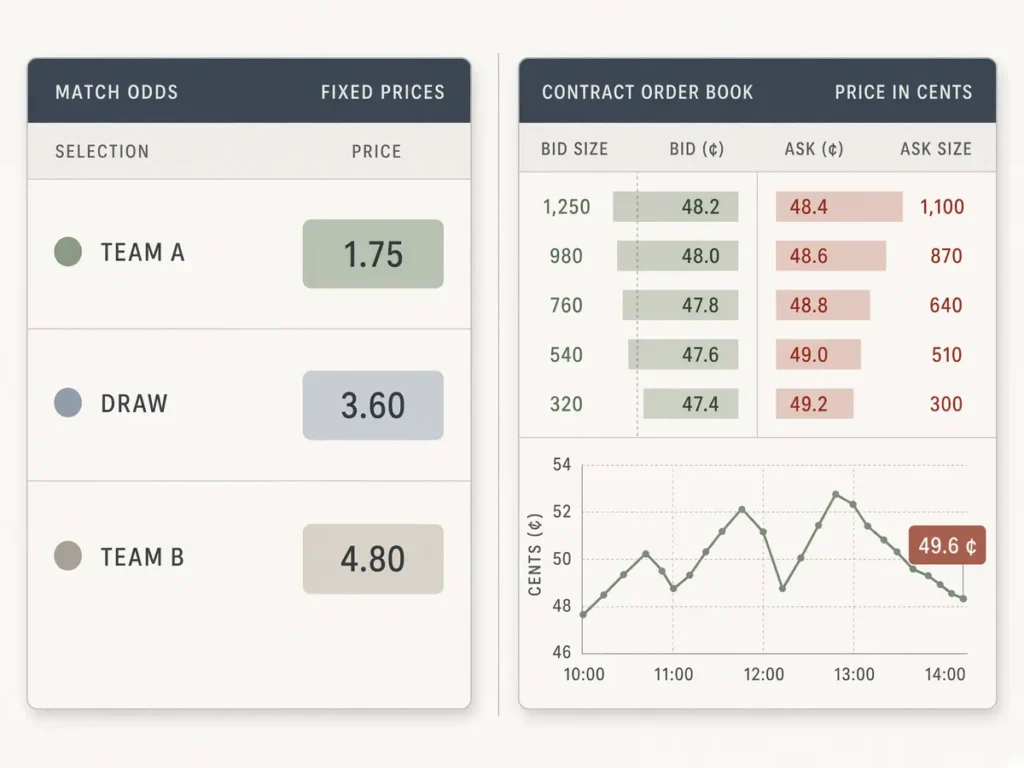
When you back a team, who actually decided the price you got? If the answer is “the sportsbook”, you are placing a bet in the traditional sense. If the answer is “whoever was willing to take the other side at that moment”, you are trading an event contract on a prediction market. That single difference drives almost everything else, and it is the thing most of the current coverage skips over.
So, prediction markets explained in one breath: a prediction market is a venue where people buy and sell contracts tied to real-world outcomes, with the price set by trading rather than by a bookmaker’s odds compiler. The reason it is suddenly everywhere is regulatory friction. Google now restricts prediction market advertising, including in Connecticut, Michigan, Nevada, New York and Ohio, each of which has taken legal action against operators offering event contracts. Sports-event contracts are not available in Nevada or Michigan at all. Meanwhile operators are suing states back, arguing federal commodities regulation puts them outside state gambling law. Nobody has a final answer yet, which is precisely why you should understand the mechanics before you form a view.
Prediction markets explained: event contracts and yes/no shares
An event contract is a binary instrument that pays out a fixed amount if a stated event happens and nothing if it does not. On most platforms the payout is $1 per contract, and contracts trade somewhere between 0 and 100 cents before settlement. Buy a “yes” share at 38 cents and you are risking 38 cents to make 62.
Because the payout is fixed at a dollar, the price itself reads as a probability. A contract trading at 38 cents carries an implied probability of roughly 38%. That is the same arithmetic you already do with decimal odds, where 1 divided by the price gives you implied probability, just expressed in cents instead of odds. The difference is who produced the number. On a prediction market it comes out of an order book, from bids and offers meeting, not from a pricing model with a margin baked in.
In the United States, the platforms operating legally in this lane are registered with the Commodity Futures Trading Commission as designated contract markets, the same regulatory category used for futures exchanges. That classification is the hinge on which the entire legal argument turns, and it is being litigated right now. Treat any statement about a specific platform’s current standing, including this one, as something to re-check rather than something settled.
How prediction markets work, from first trade to settlement
Three things happen in sequence: the contract lists at a price, that price moves as people trade on new information, and at the end the contract settles at $1 or $0 against the real outcome. The platform earns a trading fee on activity rather than a margin built into the price.
A worked example, using illustrative numbers
Say a basketball game has a “Team A wins” contract. It opens with yes trading around 55 cents and no around 45. You buy 100 yes contracts for $55 total.
An hour before tip-off, Team A’s starting point guard is ruled out. Sellers flood in and yes drops to 42 cents. You now have two choices. Sell your 100 contracts at 42 cents, crystallising a $13 loss, or hold and let the game decide. Nobody offers you a cash-out figure; you take whatever the order book is bidding.
If you hold and Team A wins, each contract settles at $1. Your 100 contracts return $100 against the $55 you risked, a profit of $45 before fees. If Team A loses, the contracts settle at zero and the $55 is gone. There is no partial outcome, no push, no half-win. The resolution source written into the contract terms decides, and if that source says no, you lose even when you were morally right.
Sports betting vs prediction markets: where the mechanics part ways
The honest headline is that both put money at risk on an uncertain outcome and both have a cost of participation. What changes is who sets the number, how the cost is collected, and how you get out.
| Mechanic | Sportsbook | Prediction market |
|---|---|---|
| Who sets the price | The operator’s traders and models | Buyers and sellers in an order book |
| How you pay | Vig built into the odds (both sides priced under true value) | Trading fee plus the bid-ask spread |
| Payout structure | Fixed odds applied to your stake | Each contract settles at $1 or $0 |
| Exiting early | Cash-out, if offered, at the operator’s price | Sell your position at whatever the market bids |
| Bet sizing | Limited by the operator’s posted maximums | Limited by how many contracts someone will trade with you |
| Regulator (US) | State gambling regulators under a state licence | CFTC, as a derivatives exchange |
Look at the cost line again, because this is where people get careless. A standard two-way market at -110 both sides gives each outcome an implied probability of 52.38%. Add them together and you get 104.76%, so the book is holding roughly 4.55% of the money wagered on a balanced market. That is the vig, and it is unavoidable once you take the price.
Exchange-style pricing is often sold as cheaper, and on a liquid market it genuinely can be, since yes and no will trade close to a combined 100 cents with the platform taking a stated fee instead. But the spread is a cost too. On a thinly traded contract, where the best bid is 40 and the best offer is 48, you are paying far more to get filled than any sportsbook would charge you. I would not assume an exchange is the cheaper venue without looking at the actual book first. Fee schedules change, so read the current one rather than trusting a figure quoted in an article.
Two regulators, two rulebooks
Sports betting in the US is licensed and supervised as gambling by state regulators, state by state, with the licence conditions, tax treatment and advertising rules that come with that. Prediction markets registered with the CFTC sit in the derivatives lane instead, overseen as commodities markets at federal level. Same economic activity in the eyes of many observers, two completely different bodies of law.
That is why a platform can list contracts on the outcome of a game in a state where it holds no gambling licence. Its argument is that federal commodities regulation occupies the field and preempts state gambling statutes. Several states disagree strongly enough to issue cease-and-desist orders, and operators have gone to court rather than back down. Underdog, for instance, sued Tennessee, its attorney general and the state’s Sports Wagering Council after being warned it faced fines, civil penalties and the loss of its fantasy sports licence, arguing that CFTC oversight exempts it from Tennessee gambling law. It has brought similar actions against several other states. None of this is resolved, and anything you read, including the paragraph you just read, can be overtaken by a ruling.
Why states and leagues call these contracts gambling by another name
The objection is straightforward. A retail customer in, say, Ohio, picking a team to win on Sunday afternoon is doing the thing state gambling law was written to supervise, regardless of which federal agency signs off on the venue. State regulators point to the consumer protections attached to a gambling licence, including advertising limits, self-exclusion registers and integrity reporting, and argue those obligations do not travel with a derivatives registration. Sports leagues raise the integrity angle, since contracts on individual performance create the same manipulation incentives as prop bets. It is the same structural question raised by the scrutiny gap between licensed sportsbooks’ draft bets and Kalshi’s event contracts: identical-looking products, different rulebooks, different levels of oversight.
Kalshi and Polymarket, concretely
Kalshi is a US exchange registered with the CFTC that lists event contracts on economics, politics, current events and sports. You fund an account in dollars, trade contracts against other users, and the platform collects trading fees. Its availability for sports contracts is not uniform across states, as the Nevada and Michigan situation shows.
Polymarket is a crypto-based prediction market that settles in stablecoin rather than bank dollars. For years it was not open to US retail traders following enforcement by the CFTC, and its relationship to the US market has been shifting. Before you assume you can legally open or fund an account on either, check the platform’s current terms and your own jurisdiction’s position. Access that existed last quarter may not exist now, and the reverse is also true.
Is trading an event contract gambling?
Functionally, yes. Legally, in several jurisdictions, no. Both halves of that are true at once, and pretending otherwise is how people talk themselves into trouble.
Functionally, you stake money on a binary outcome you cannot control, you win or lose depending on something random to you, and participation carries a cost that means the average player loses over time. That is a wager by any ordinary reading. Structurally and legally, a CFTC-registered event contract is a derivative, traded on an exchange, with hedging and price-discovery justifications that a parlay on Sunday’s games does not have.
What the classification does not do is reduce the risk. Being told your position is a financial product rather than a bet does not make the money less gone when the contract settles at zero. If anything, the trading frame is the more dangerous one psychologically, because it invites you to treat losses as portfolio variance rather than as losses.
What I would weigh before using either kind of platform
Start with legality, because it is the only factor that can cost you access to funds mid-position. Licensed sportsbooks tell you plainly which states or countries they serve. Prediction markets in the contested lane may be offering sports contracts into a jurisdiction that is actively trying to stop them, and if a court or regulator succeeds, you could find a market pulled or an account restricted while you hold open positions. Check the rules where you live, not where the platform is based, and do not lean on an offshore gambling platform as a workaround.
Then cost. Compare the sportsbook’s hold on the specific market you want, roughly 4.55% at -110 on a two-way line, against the exchange’s trading fee plus the real spread on the contract you intend to trade. On popular markets the exchange often wins that comparison. On obscure ones it frequently does not.
Then the practical details nobody reads until they matter. What resolution source settles the contract, and what happens if the event is postponed or void. Whether there is enough depth in the book to sell a position of your size. How winnings are taxed where you live, since derivatives and gambling income can be treated differently and that is a question for a tax professional, not an article.
And treat both as speculative spending, not income. Set a figure you can lose without it changing anything in your month, use the deposit and loss limits the platform offers, and walk away from any session where you are trading to recover something. If it stops being discretionary, the self-exclusion and cool-off tools exist for a reason.
The mechanics above are stable and you can rely on them. The legal boundary is not. Courts are still deciding whether a federal commodities registration really does override a state’s gambling statutes, and whichever way that lands will reshape which of these products you can legally touch, and under whose protection. Anyone telling you the answer today is selling you something.