

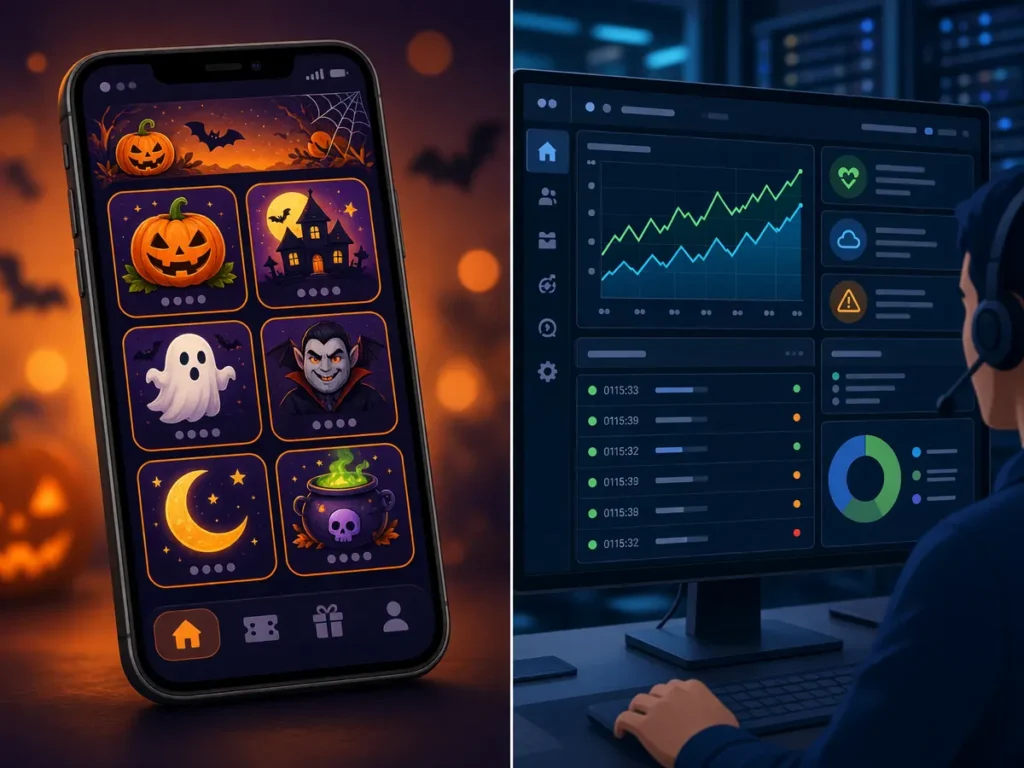
The Halloween reskin sitting at the top of your lobby is not marketing fluff, and it is also not proof that the casino behind it is well run. Seasonal slot updates are worth reading as an operational signal, but the signal is in the execution, not the pumpkins: whether the game launched tested, whether the promo terms match what the game actually does, whether the lobby stayed up while the drop rolled out. A platform that ships a themed release every six weeks and breaks something every time is telling you more about itself than one that ships twice a year and never breaks anything.
That is the argument of this piece, and it comes with a sharp limit I will come back to at the end: a busy lobby is cheap to fake, and a quiet one is not automatically a warning.
What actually counts as a seasonal slot update
A seasonal slot update is any date-tied change to the game catalogue: a new themed title built for a holiday, a cosmetic reskin of an existing game engine, or a limited-time promotional layer scheduled around an event. The three are not the same thing, and conflating them is the most common mistake players make when they judge a lobby by how fresh it looks.
- New themed releases, where the art, sound and often the feature set are built from scratch, with their own paytable and certified math.
- Reskins, where a proven engine gets new symbols and a new name. The volatility and RTP are usually inherited from the original, which is why a “new” Christmas slot can feel oddly familiar on the tenth spin.
- Seasonal casino promotions layered over existing games: prize drops, leaderboards, free spin campaigns and jackpot events scheduled for Halloween, Christmas, Diwali or a cricket season on India-facing platforms.
Only the first category represents real studio investment. The third category is where most operators actually spend their effort, because it is the cheapest to produce and the easiest to market. Knowing which one you are looking at changes what you can infer from it.
Why online slot studios keep rebuilding the same lobby
Studios and operators refresh catalogues on a schedule because attention decays and lobby position is finite. A game that has been live for eighteen months drifts down the grid; a seasonal release gets a banner, a carousel slot and a push notification. Retention is the stated reason in every operator deck, and it is honest as far as it goes.
The less obvious reason is that a content calendar is a commitment between a studio and the operators who carry it. Missing a scheduled drop, or shipping it broken, costs a studio placement across dozens of lobbies at once. Regular releases are also how a studio demonstrates it still exists as a going concern, which matters when operators decide whose games to integrate next year.
The physical side of the industry runs on exactly the same logic, and it is instructive. Stanislav Kriuk, Production Director at ICONIC21, an iGaming content provider whose portfolio spans live casino games, slots and virtual games, has described how live casino studios handle seasonal set changes: the work is planned weeks ahead to avoid disrupting live tables, decorations are camera tested because what reads well in the room can read badly on a stream, designs have to support the operator’s brand rather than look like generic bunting, and installation happens table by table inside maintenance windows, followed by camera, lighting and sound checks. Fire safety, emergency access and ventilation stay non-negotiable throughout. The decoration is the visible fraction. Everything that makes it work is invisible to the player watching the stream.
Online, the invisible fraction is QA, certification and deployment. Same principle, different infrastructure.
The operational excellence behind a refresh that works
Casino operational excellence during a game release shows up in four places: testing before launch, certification of any changed math, platform uptime during rollout, and promotional terms that describe the game as it actually behaves. Get all four right and the player sees nothing at all, which is the point.
Certification deserves a word, because it is the one most players wave through. A cosmetic reskin that leaves the paytable untouched is a different proposition to a variant that alters features or payouts. Where the math changes, the game is functionally a new game for a testing laboratory, and regulated markets expect independent verification of the RNG and the return model before it goes live. Requirements differ by jurisdiction and licence, so treat any specific claim about a particular certificate as something to verify on the regulator’s or lab’s own published records rather than on the casino’s banner.
Signs of a well-run refresh versus a rushed one
The table below is built around what a player can actually observe from the outside.
| What to look at | Well run | Rushed |
|---|---|---|
| Release notes | Published, dated, name the games and the changes | No notes; games appear and vanish silently |
| Platform uptime | Lobby and cashier unaffected during the drop | Login errors, games failing to load on launch day |
| Game information | RTP, volatility and max win visible in-game and in the lobby | RTP missing, or contradicting the provider’s own figure |
| Promo mechanics | Terms match the feature; qualifying games listed correctly | Promo pages still live after expiry; games listed that are not in the lobby |
| Mobile build | Same layout logic, buttons reachable, no clipped UI | Desktop art squeezed into a phone frame |
| Bug response | Known issues acknowledged, fixed in days | Same complaint repeated for months in support threads |
Themed online slots and what theme quality really tells you
Theme execution reveals the budget behind a game, not the integrity of the casino carrying it. Original artwork, recorded audio that reacts to the feature round, a bonus mechanic that belongs to the theme rather than being bolted on, and a mobile build that was designed rather than scaled: all of that costs money and signals a studio investing in its own catalogue.
What matters more to you as a player is whether the numbers travel with the game. Many providers ship titles in multiple RTP configurations, and the operator picks which one to run. A serious platform publishes the figure it has deployed. A careless one publishes nothing, and you end up spinning a game whose return you cannot check. That gap is visible even at the trade-show stage, as with Novomatic’s Halloween-themed Ghost Party, shown at G2E 2026 with no published RTP or payline count. A slick theme with no disclosed math is a marketing asset, not information.
Red flags in a neglected slot game refresh cycle
A stale catalogue is rarely stale on its own. It usually travels with other symptoms, and the cluster is the warning, not any single item.
- A “New Games” row that has not changed in six months or more, while the provider list has not grown either.
- Seasonal promotions still displayed weeks after they expired, or terms pointing to games the lobby no longer carries.
- RTP figures absent from game info panels, or inconsistent between the lobby and the game itself.
- Bug reports in public forums that go unanswered across multiple releases.
- Outdated client builds, broken Flash-era assets, or games that fail to load on current mobile browsers.
- Licensing or certification details that are hard to find, out of date, or unverifiable on the regulator’s own register.
None of these proves a casino will not pay you. All of them suggest the same thing: nobody is maintaining the surfaces the player touches, which raises a fair question about the surfaces the player cannot see.
The cadence trap, and where my own line sits
There is no correct refresh frequency, and anyone quoting you one is guessing. Large lobbies add games weekly because their aggregators supply them weekly, which reflects commercial deals rather than in-house discipline. A tightly curated platform might add a handful of titles a quarter and run every one of them properly.
This is the trade-off with no clean resolution. Velocity and stability pull against each other: the fastest content calendars produce the most broken promos, and the most stable catalogues eventually go stale. I would not choose a casino because its lobby looks busy, and I would not reject one because it is quiet. What I would reject, without much thought, is a platform that ships a themed release while a previous season’s promo page is still live and wrong. That specific combination, new marketing over unmaintained marketing, is the clearest tell in the whole exercise.
Putting this to work before you deposit
Use refresh quality as one input among several, after licensing and payout behaviour, never instead of them.
- Check the date on the newest games in the lobby, and whether any provider has been added recently.
- Look for published release or maintenance notes. Their existence matters more than their content.
- Open two or three games and confirm RTP and volatility are stated in the information panel.
- Read one current seasonal promotion end to end. Do the qualifying games exist, are the dates live, does the wagering requirement state its multiplier and its game weighting?
- Verify the licence on the regulator’s register rather than trusting the footer badge, and apply the same scrutiny you would to any new slot provider’s titles before playing them.
One honest caveat on the promotions driving all this. A well-executed seasonal bonus is a sign of a tidy operation, not of a better chance of winning. Every slot keeps a house edge regardless of its theme, a 96% RTP leaves 4% to the house over the long run, and wagering requirements routinely make a headline bonus worth far less than its face value. Set a deposit limit before you look at any of it, and use the operator’s cool-off tools if the limit starts feeling negotiable.
The uncomfortable part is that every signal described here sits on the surface, and surfaces can be dressed. A disciplined-looking lobby can sit on top of slow payouts, and a plain one can sit on top of a competent operation. Refresh quality narrows the field. It does not settle it, and the question of how your withdrawal is actually handled stays open until the first time you ask for one.