

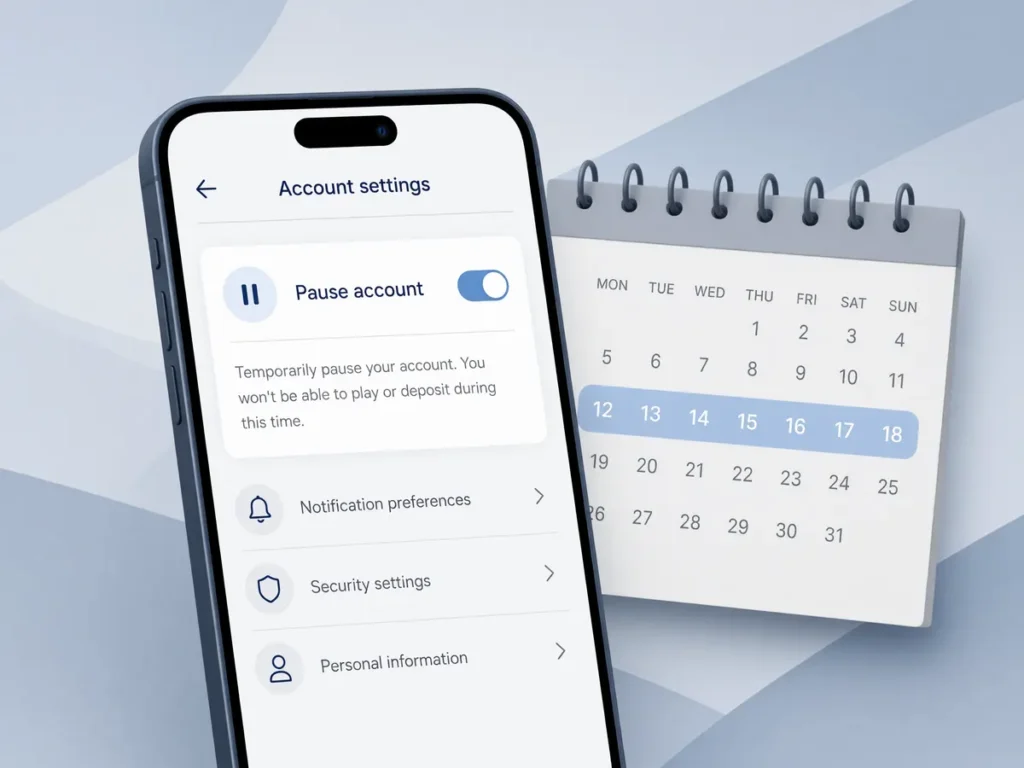
Fewer than half of self-exclusion listings say how long the block lasts
Research published by the Casino.net Research Lab examined 903 self-exclusion listings across 540 casino brands in 64 markets, and found that only 409 of those listings recorded an exclusion period. A self exclusion online casino tool is a request you make to an operator to block your own account from gambling for a defined stretch of time, so a missing duration is not a small omission. It is the single number that tells you what you are actually agreeing to.
The spread between markets is wide. In Great Britain, 117 of 132 listings (88.6 per cent) specified a period, the highest rate among the 31 markets in the study that had at least ten listings. The researchers were careful about what that gap does and does not prove: an operator whose duration was not captured in the published information may still run a perfectly effective exclusion. The documentation was thin, not necessarily the tool.
That distinction is fair, and it is worth holding onto. But it does not get anybody off the hook, for a simple reason covered further down: a player deciding whether to shut their account tonight can only act on what is written in front of them.
Myth: self-exclusion is just a longer deposit limit
Self-exclusion blocks access to gambling entirely; limits let you keep playing within a ceiling you set. They sit at opposite ends of the control scale, and mixing them up is the most common misunderstanding about casino account limits. Someone who sets a ₹5,000 weekly deposit limit still has an open account, still gets promotional email, and can still raise that limit later. Someone who self-excludes should have neither access nor the option to quietly undo it.
Deposit, loss and wagering limits
A deposit limit caps how much money you can pay into the account over a day, week or month. A loss limit caps net losses over the same kind of period, which is stricter, because recycled winnings do not buy you extra room. A wagering limit caps total stake volume, or sometimes the maximum stake per round. Most regulated operators apply an asymmetry here that catches people out: a request to tighten a limit takes effect immediately, while a request to loosen it is held for a cooling-off period before it applies. That delay is deliberate, and it is the most useful feature of limits, not an inconvenience.
Time-outs versus full self-exclusion
A time-out, also called a cooling-off period, locks the account for a short fixed spell and then releases it automatically. In regulated markets these are commonly offered as set options running from 24 hours up to around six weeks. Self-exclusion is the longer, heavier version: measured in months or years, harder to lift, and normally bundled with removal from marketing lists. If you are not sure which you need, the honest test is whether you want a break or want the door closed.
| Tool | What it restricts | Typical duration | Can you lift it early? |
|---|---|---|---|
| Deposit limit | Money paid into the account per period | Rolling daily, weekly or monthly | Tightening is instant; loosening is delayed |
| Loss limit | Net losses per period | Rolling daily, weekly or monthly | Same delay on increases |
| Wagering limit | Total stakes, or stake per round | Per session or per period | Same delay on increases |
| Session or time limit | Length of play, with reminders | Minutes or hours per session | Usually yes, between sessions |
| Time-out (cooling-off) | All gambling on the account | Fixed options, 24 hours to several weeks | Generally no, it runs to the end |
| Self-exclusion | Account access and marketing contact | Months, years or permanent | Not before the minimum term ends |
Exact options differ by operator and by the regulator licensing them, so treat this as the shape of the system rather than a guarantee of what any single account offers.
What vague wording actually costs you
Ambiguity in self-exclusion terms costs players the ability to plan, and in the worst case it hands an account back to someone who thought it was shut for good. Three details carry almost all of that weight: how long the exclusion runs, what has to happen before it ends, and which brands it covers.
Consider what happens when duration is unstated. A player at a difficult moment opens the responsible gambling page, finds a self-exclusion option with no term attached, and has to guess whether clicking it buys a week or five years. Some will click anyway. Others will close the tab and keep playing, which is the outcome the tool exists to prevent. The same applies to reversal: if the page does not say whether the block can be undone, a player cannot judge whether it will hold on a bad night, which is precisely the night it has to hold.
So there are two defensible readings of the research. One says the gap is clerical, because the underlying protection may function fine and only the published record was incomplete. The other says publication is the protection, because a tool nobody can understand before using it is a tool that goes unused. The second reading is the one that matters for players. An exclusion that works flawlessly and is described in forty vague words is still a worse product than a plainly documented one, because the decision to use it is made by a person reading a page, under pressure, with no appetite for emailing support to ask how long a ban lasts.
How to set up self-exclusion on your account
The route is broadly consistent across licensed sites, even where the detail varies.
- Open account settings and look for the responsible gambling, responsible play or safer gambling section, usually alongside limits and verification.
- Choose self-exclusion rather than time-out if you want the longer block, and read the term shown on screen before confirming.
- Select a duration from the options offered. In some regulated markets, including Great Britain, a minimum of six months is standard practice.
- Complete any identity check the operator requires. Account verification exists so the block attaches to you, not just to one login.
- Confirm, then wait for written confirmation by email stating the start date, the end date and whether marketing has been switched off. If that confirmation does not arrive, contact support and keep the reply.
Where no self-exclusion option appears in the account area at all, that is itself information about the operator. A request by email or live chat should still be honoured and logged, but the absence of a self-serve control is a reasonable reason to question what other player protections are missing.
What happens once the exclusion is live
You should lose the ability to deposit and place bets, and the account is normally closed to login or placed in a restricted state for the full term. Any withdrawable balance should be paid out rather than held hostage. Promotional email, SMS and push notifications are meant to stop as well, though this is the part that most often slips, particularly where an operator runs several brands on one platform and only one is flagged.
Can self-exclusion be reversed?
Not during the minimum term, under any properly run policy. After it expires, reinstatement is usually not automatic either: a player typically has to ask, wait out a short cooling-off window, and actively confirm they want the account back. That friction is the point. The better operators make it slower to come back than it was to leave, and a site offering instant reinstatement on request has, in practice, sold you a time-out and called it something stronger.
Myth: one exclusion covers every casino you use
Self-exclusion applies only where you set it, unless it feeds into a multi-operator scheme. A block on one brand usually covers that operator’s other sites on the same licence, and nothing beyond. Several regulated jurisdictions run central registers that push one request across every licensed operator in the market, which is the version that genuinely works, because it removes the obvious workaround of signing up somewhere else twenty minutes later.
For players searching for self exclusion India options, the practical position is harder. Online real-money gambling in India is governed unevenly across states and much of the market players actually reach is operated under foreign licences, so there is no single register that reaches every site available to an Indian player. The honest consequence is that single-site exclusion leaves the rest of the internet open. Pairing it with device-level blocking software and, where your bank supports it, a gambling transaction block closes more of the gap than any one operator’s settings page can.
When the tools are not enough
Self-exclusion manages access; it does not treat the reason the access became a problem. If the urge persists through a block, or returns the moment one expires, that is a signal to talk to someone rather than to set a longer term. In India, Tele-MANAS, the national tele-mental health service run under the Ministry of Health and Family Welfare, provides free counselling support by phone, and Gamblers Anonymous runs peer support meetings, including online. A GP or a qualified mental health professional can refer you further.
Check any service before you share details with it, because the people running support services are not automatically above scrutiny: Philip Lee Sullivan was convicted of stealing $1.4 million from a Panama City Beach real-estate company, not from the helpline he directed. The point is narrower than it first looks, and worth stating plainly, as the case of the Florida gambling helpline director shows: the theft was from an unrelated employer, but it is still a reason to verify who you are dealing with. Look for a named parent body, a registration or government affiliation, and no request for payment or account access.
What the Casino.net figures leave unresolved is how many of those 494 listings without a stated period reflect poor record-keeping and how many reflect a tool nobody could use with confidence. Until that is settled, the only reliable move is to read the term before you need it: find the responsible gambling page on the site you use, note the exclusion options and the reversal rules, and decide now which one you would pick. The page is much easier to read on a quiet afternoon than at two in the morning.