

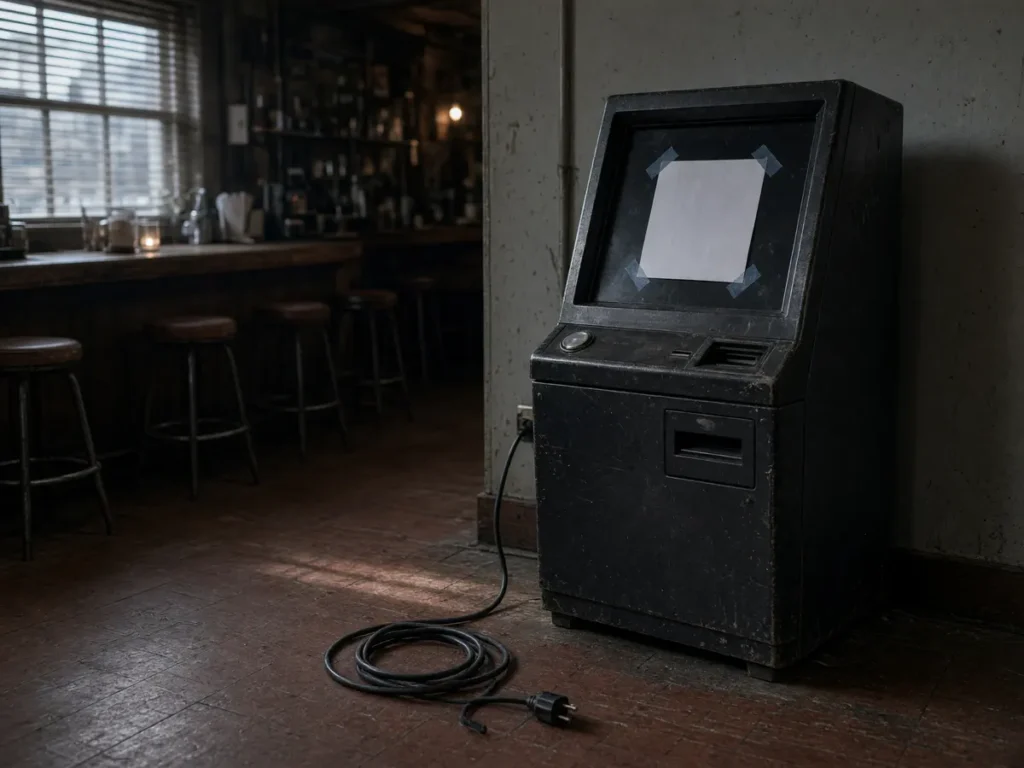
A skill game is a cash-paying gaming machine whose operator argues it sits outside gambling law because the player, not a random number generator, determines the result. In Pennsylvania, that argument has now run out of road: the state Supreme Court ruled on June 15, 2026 that skill games are slot machines under state law and unlawful unless licensed, and the window to clear them out has closed.
Most people reading that headline reached the right conclusion and got there the wrong way. The common take is that skill games were always “just slots in disguise”, so of course they lost. But the machines did not fall because a court decided the skill element was fake. They fell because taking money on a machine in exchange for a prize is a licensed activity, and adding a player-input layer does not exempt anyone from licensing. That difference is the whole of skill games regulation, and misreading it is what left an entire distribution chain holding equipment it cannot legally deploy.
What a skill game is, and what the label was really doing
A skill game terminal looks like a slot cabinet, takes cash, and pays cash. The design difference is a feature that gives the player some control over the outcome: a memory step, a nudge, a puzzle element, or a prompt that reveals whether the next play is a winner. The manufacturer’s position is that because outcomes can be influenced or predicted, the machine is not a gambling device at all.
The label was never a technical description. It was a jurisdictional claim, written for the specific wording of each state’s gambling statute. Licensed operators and the American Gaming Association spent years arguing, as AGA government relations vice president Tres York put it after the deadline, that the industry was running “so-called” skill games that are illegal slot machines. That is the fight in one phrase: not whether players can get good at the game, but whether the statute cares.
How gambling law separates skill from chance
Three questions decide it in most US jurisdictions: does the player pay to take part (consideration), is there a prize, and is the result determined by chance. Consideration and prize are rarely in dispute on a cash-in, cash-out machine. The entire argument happens on the third element, and courts resolve it with one of several competing tests.
The most widely used is the predominance test: if chance predominates over skill in determining outcomes across ordinary play, the machine is a gambling device, even where skill clearly matters. A minority of states apply a material element test, which catches a game where chance plays a meaningful part without necessarily dominating. A few apply an any-chance test, which is close to unloseable for the operator. Which test applies is a matter of state law, not of game design, which is why identical hardware can be legal in one state and seizable across the border.
The case for an exemption
Operators argue that a player who studies the machine can identify winning plays and, in theory, avoid the losing ones. Skill is therefore the controlling factor, the machine is a game of skill, and the licensing regime built for casino slots simply does not reach it. The argument has real force in jurisdictions whose statutes define a slot machine narrowly, and it held in Pennsylvania for roughly 13 years.
Why regulators usually win it anyway
Regulators and courts tend to look past the feature and at the behaviour. If the typical player feeds cash in and takes a result out without exercising the skill element in any consistent way, the skill component is treated as decorative rather than determinative. And where a statute defines a slot machine by its function, cash in, random-ish result, cash out, the skill layer never gets to the predominance question at all. Pennsylvania’s Supreme Court took the statutory route: skill games are slot machines, and slot machines without a licence are unlawful.
Why Pennsylvania put a clock on it
The court did not order immediate removal. According to CDC Gaming’s reporting, it stayed enforcement of the June 15, 2026 ruling for 120 days to give the legislature a chance to build a regulatory system for the machines, taxing them, licensing them, and deciding where they could sit. Lawmakers did not reach agreement. The Supreme Court then denied requests to extend the removal deadline, and an estimated 70,000 terminals statewide became officially illegal the following day.
That sequence is the part worth remembering. The machines were not banned on principle; they were given four months to become legal and the political process failed to deliver a route. Enforcement is the default outcome when regulation does not arrive, not the preferred one.
How 70,000 terminals ended up in bars and corner shops
They multiplied because nothing stopped them. The machines operated without comprehensive statewide regulation for about 13 years, from Pace-O-Matic’s 2013 introduction of the machines to the June 2026 Supreme Court ruling, and during that period the economics were close to irresistible. A bar or a volunteer fire company could host a terminal with no licence, no gaming tax, and no capital cost, taking a share of revenue from equipment someone else owned and serviced.
That created a distribution industry on top of the gap. Joe Rocca, owner of Rite Touch Distribution in Pittsburgh, told CDC Gaming that 99% of his business was leasing skill game terminals to customers, with the remaining 1% outside Pennsylvania “not enough to sustain the business”. He expects to be sitting on 1,000 terminals once removals finish, and predicts the equipment will end up “in landfills or on the used markets”. Notably, Rocca agreed the terminals should have been regulated, just not placed anywhere, telling CDC Gaming he did not think they belonged “in a hair salon”.
That is the cost of betting a business model on an unresolved legal question: the asset does not depreciate gradually, it goes to zero on a court calendar.
What a business risks by leaving one plugged in
The Pennsylvania State Police warned a month before the deadline that any skill game operating after it is subject to immediate seizure, and that business owners may face criminal prosecution. That is the enforcement posture as reported: confiscation first, charges possible. Pace-O-Matic, the main manufacturer behind the machines, said in a statement to CDC Gaming that it is complying and that its message to operators and locations has been to “follow the law” and ensure games are not available for play.
Beyond seizure and prosecution, the usual toolkit in these cases includes cease-and-desist orders and administrative penalties, and for any business holding a liquor or lottery licence, the licence itself is exposed. Specific fine amounts vary by charge and are not something to guess at; where a figure matters to a decision, it should come from the statute or the enforcing agency, not from a summary like this one.
Why other states are watching the docket
Gray-market terminals are not a Pennsylvania problem. Similar machines sit in bars and convenience stores across several states where legislatures have not written a clear statute, and every one of those legislatures now has a worked example: a supreme court reading existing slot machine language broadly, a stay granted for a regulatory fix, and seizure powers switching on when the fix did not arrive.
The structural complaint from the licensed side is about asymmetry rather than morality. A casino or online operator pays licence fees, submits games for independent certification, files tax on gaming revenue, and carries compliance staff. Penn Entertainment’s Jeff Morris, speaking after the deadline, described an industry that “for years has flagrantly ignored responsible-gaming protocols and consumer protections, while providing zero tax revenue for the Commonwealth”. Whatever you make of the source, the cost difference between a licensed and an unlicensed game is not rhetorical.
| Requirement | Licensed casino or iGaming title | Unlicensed skill game terminal |
|---|---|---|
| Operating authority | State gaming licence | None |
| Game certification | Independent test lab, RTP verified | No standing requirement |
| Gaming tax | Paid on gross gaming revenue | None reported by the state |
| Player disputes | Regulator complaint channel | Whoever owns the cabinet |
| Responsible-gambling tools | Mandated under licence conditions | Not guaranteed |
| Status after the deadline | Lawful | Subject to seizure |
What licensing actually buys the person playing
The practical difference for a player is verification and recourse. A licensed slot has had its return to player figure tested by an independent lab and its random number generator examined as a condition of approval, which means the advertised maths and the actual maths have been checked by someone with no stake in the result. The house still has an edge on every one of those games, and over time it wins; licensing does not change that and was never meant to. It changes whether the edge is the one disclosed.
The rest is unglamorous and matters more than it sounds: a named regulator to complain to when a machine eats a payout, enforced limits and self-exclusion options, and rules on who can play and where. An unlicensed terminal in a corner shop offers none of that by default, and when it is seized, there is no regulator holding a balance on the player’s behalf. Anyone who finds their play is no longer a choice should contact a national gambling helpline rather than the venue.
What Pennsylvania has not settled is where the machines go next. The court answered a question about statutory definitions; the legislature’s question, whether to license, tax and site these terminals properly, is still open, and the hardware is still sitting in warehouses waiting for an answer. Other states will get the same choice, in the same order, and the one lesson worth taking from Pittsburgh is that the choice gets made either way.