

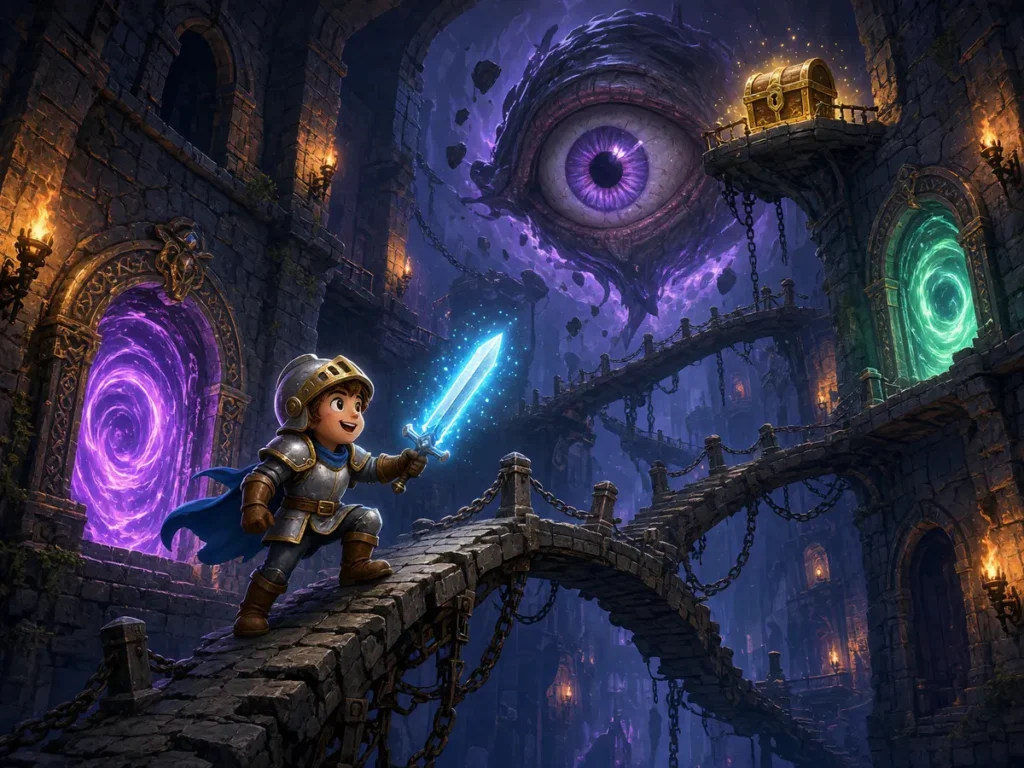
Nine winning clusters in a single spin. That is the number Play’n GO has put at the centre of its new release, and it is also the quickest way to understand why Tower Run Treasure Steps is a cascading slot, not a crash game, no matter how much the climbing theme suggests otherwise. The tower rises, the rewards escalate, and at no point does the player decide when to stop. That last part is the whole difference.
Plenty of players saw the announcement, read “climbing towards trouble”, and mentally filed it next to Aviator. Understandable. It is also the mistake worth correcting before you load the game, because the two formats hand you entirely different kinds of control, and the one thing crash players actually enjoy, the cash-out button, is not in this slot.
What Play’n GO has confirmed about the game
Tower Run Treasure Steps is a Play’n GO slot built on a 5×5 cascading grid, starring Bob, an aspiring knight with a glowing sword and, by the studio’s own description, a limited amount of experience. He is climbing the Treasure Tower in search of the Treasure Room. The setting is all suspended walkways, strange portals and heavy stonework, with a giant floating eye watching the action.
Symbols pay anywhere on the grid rather than along fixed paylines, which puts the game in the pay-anywhere cluster family rather than the classic payline camp. Wins charge a progression meter Play’n GO calls the Win-O-Meter of Destiny.
What the launch announcement does not give is an RTP figure, a volatility rating, or a maximum win. That is normal for a studio press release and it is also the first thing I would want before playing anything. The game lobby or help file will carry the certified RTP; the marketing copy never does. If you have followed slot launches at trade shows, you will recognise the pattern from releases like Novomatic’s Ghost Party reveal, where no RTP or paylines were published either.
How the climb actually works
The climb is a win-count progression inside a single spin, not a series of voluntary steps. Here is the sequence as Play’n GO describes it:
- You spin the 5×5 grid and matching symbols pay anywhere they land.
- Winning symbols clear and new ones cascade in, so one spin can produce several wins in a row.
- Each win charges the Win-O-Meter of Destiny. The earlier stages of that meter unlock the Wild Rift and the Dimensional Multiplier features.
- Reach nine wins within the same spin and the Treasure Room unlocks once every cascade has finished resolving.
Read that again and notice what is absent. There is no point where the game pauses and asks whether you want to bank what you have or push for the next step. The cascades either keep producing wins or they stop, and when they stop the spin is over. The monsters, the trouble and the floating eye are narrative dressing on a maths model that resolves by itself.
Play’n GO has not detailed exactly what happens inside the Treasure Room, so I am not going to guess at it. If the Treasure Room contains its own step-by-step, keep-going-or-collect decision, that would change this comparison, and the help file will be the place that says so.
What a crash game like Aviator actually does
A crash game runs a live multiplier that starts at 1.00x, climbs continuously, and ends at a randomly determined point. Cash out before it crashes and you keep your stake multiplied by whatever figure was on screen when you pressed the button. Leave it a second too long and the stake is gone. Aviator, built around a plane that climbs until it flies off, is the title most players know, and it has a large following among Indian players alongside live Teen Patti and Andar Bahar.
Three structural features define the format. The round is shared, so everyone in the lobby is betting on the same curve and can usually see other players’ cash-outs. The round has no fixed length, because the crash point varies from an instant to a long run. And the exit is yours to choose, including through auto cash-out at a preset multiplier.
Most crash titles also publish a provably fair verification method, where server and client seeds combine into a hash you can check after the round to confirm the result was not altered. Slots take a different route to the same goal: a certified RNG tested by an independent laboratory, with the outcome fixed at the moment of the spin.
The real overlap is escalation, not decision
What the two formats genuinely share is the shape of the tension. Both build a sense of accumulating progress inside a single round, both tie bigger rewards to going further, and both are paced so that the interesting moment is the one right before everything resolves. Play’n GO is clearly borrowing that feeling. A climbing meter that unlocks features in stages is reaching for the same nerve a rising multiplier reaches for.
The honest limit on the similarity is that in a crash game the escalation is a question put to the player, and in Tower Run Treasure Steps it is an outcome reported to the player. Theme borrows from crash; mechanics do not.
Where the two formats part ways
Round structure and pacing
A slot spin is a closed, single-player event. You set the stake, the RNG determines the result, the cascades resolve, and the round ends. Nobody else is in it with you and nothing you do after pressing spin changes the outcome. A crash round is open-ended and usually populated: the curve is generated in real time for everyone at once, there is a betting window before it starts, and the length of the round depends on where the crash lands.
Math model: paytable versus live multiplier curve
In a slot, your return comes from a published paytable and feature set, with the game’s RTP certified across millions of simulated rounds. Typical slot RTP sits in the 94 to 97 percent range, which means a house edge of roughly 3 to 6 percent. In a crash game, the house edge is built into the distribution of crash points, and your realised return depends heavily on the cash-out multiplier you habitually target. Low multipliers hit often and pay little; high ones rarely land. Neither approach changes the underlying edge, which is the part some crash guides quietly skip over.
| Mechanic | Slot climb feature | Crash game |
|---|---|---|
| Who ends the round | The game, when cascades stop | The player, by cashing out, or the crash |
| Round length | Fixed by the spin resolving | Variable, from instant to extended |
| Participants | Single player | Usually shared with a live lobby |
| Outcome generation | Certified RNG, fixed at spin | Curve generated live each round |
| Fairness check | Independent lab certification | Provably fair seeds and hashes |
| Reward source | Paytable, features, multipliers | Multiplier at cash-out |
Who this format suits
Crash players curious about slots will find the escalating structure familiar and the loss of control frustrating, and that reaction is worth anticipating rather than discovering mid-session. If what you like about Aviator is the judgement call, a cascading slot with a progression meter will not replace it. If what you like is the build-up, Tower Run Treasure Steps delivers it with cleaner maths and a published RTP you can actually read.
Slot players come at it from the other side, and for them the meter is simply a well-dressed feature ladder, closer in spirit to other recent progression systems such as Booming Games’ PowerGrid mechanic than to anything in a crash lobby.
Two things remain open until the game is live: the certified RTP and volatility, and what the Treasure Room pays once nine wins unlock it. Check both in the game’s help screen before you stake anything, set a deposit or session limit first, and treat the climb as entertainment rather than a plan. The tower, like every other game in the lobby, is built to keep a margin.