

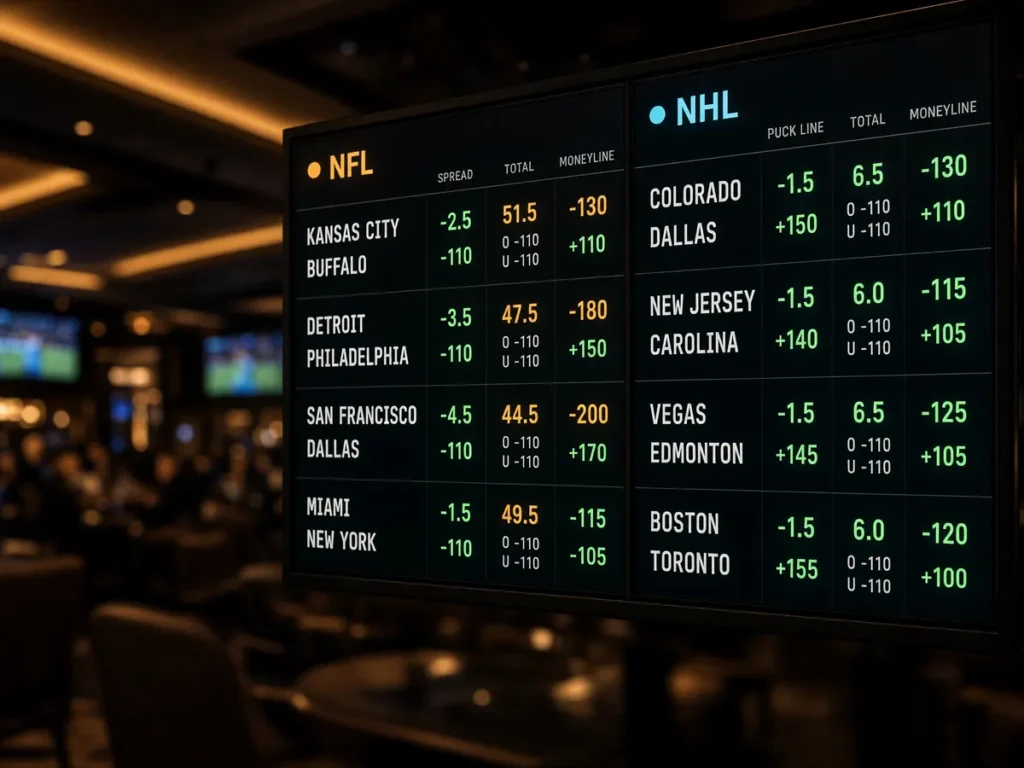
A line is a price, not a prediction
Vegas sportsbook odds are a price on an outcome, set close to the market’s estimate of probability and then adjusted by where the money goes. That second half is what most readers skip. A number that looks like a forecast is really a number a trading desk is comfortable holding both sides of, and the difference shows up most clearly when a team is slumping or when two division rivals meet.
This week’s Vegas Sports Report from casino.org gives two clean test cases: the Raiders’ collapsing ground game ahead of their home date with Buffalo, and the Golden Knights heading to Nashville on the second night of a back-to-back. Neither story is a tip. Both are useful for seeing how the sausage is priced, which is the part that still applies in December, in March, and next season.
What the report actually hands an odds reader
Per casino.org, Las Vegas is averaging 82 rushing yards per game, fifth-worst in the NFL, and managed 38 on the ground in a 45-17 loss at New England. Ashton Jeanty took 10 carries for 27 yards while nursing an ankle sprain and a plantar fasciitis flare-up; on the season he has 328 yards on 106 carries, about 3.1 per carry, with one rushing touchdown. ESPN data cited in the report has New England blitzing the 38-year-old Kirk Cousins on 41.2% of his first-half drop-backs. Head coach Klint Kubiak took responsibility for abandoning the run early.
On the ice, the Golden Knights are 5-2-0 and a point clear atop the Pacific Division, but they trailed 3-0 in the first period against Minnesota on Monday, the third time in seven games they have given up that early a hole, and went 0-for-5 on the power play. Nashville took four of six points on a Canadian road swing.
None of that is a line. It is the raw material a line gets built from, and the honest move is to read it that way rather than hunting for the number it “should” produce.
How sportsbooks price a struggling NFL team
A slump moves a line through three channels: the power rating, the injury inputs, and the matchup fit. Power ratings get nudged when results deviate from expectation, so a 45-17 loss costs more than a close one. Injury inputs are discrete rather than gradual, and a running back playing hurt is typically already in the number. Matchup fit is where the real work happens, and it is the condition people forget to check.
Here is the complication. The reason Vegas’s offense cratered in Foxborough was pressure on a statue-footed quarterback with no run game to lean on. Buffalo, by the Pro Football Reference figures in the report, blitzes less than almost anybody.
| Upcoming Raiders opponent | Blitz rate | NFL rank |
|---|---|---|
| Buffalo Bills | 16.3% | 28th |
| New York Jets | 25.8% | 12th |
| Los Angeles Rams | 23.0% | 17th |
| League average | 24.5% | — |
Two readings are defensible. One says the slump is self-compounding: a hurt back, a line that cannot create movement, and a quarterback who has never escaped pressure means the offense underperforms regardless of scheme, so the spread deserves to keep widening. The other says the run-game numbers are old news to the market and the live variable is whether this specific defense attacks the weakness, which Buffalo’s 16.3% blitz rate suggests it may not by design.
I lean to the second, with a caveat. Pricing off a yards-per-game rank is pricing off something every trader already has; pricing off opponent tendency is at least asking a question the number might not answer yet. The caveat is that casino.org notes Buffalo watched New England succeed and may dial up more pressure anyway, which is exactly the sort of unpriceable coaching adjustment that makes the first reading non-stupid.
Reading the point spread and moneyline together
The spread, the moneyline and the total describe the same forecast from three angles, and a disagreement between them is information. A moneyline of -150 means you risk 150 to win 100, an implied probability of 60% before the bookmaker’s margin is stripped out; the other side at +130 implies about 43.5%. Add them and you get more than 100%, which is the margin. A spread converts that same favoritism into points so both sides can be priced near even money.
The total is the environment. A team that cannot run tends to play from behind and throw, which stops the clock and adds plays, so a run-game collapse pushes on the total as well as the side. When the spread moves toward a favorite but the total drops, the market is saying something different than when both rise together. Read all three or you are reading a third of the page.
Public perception versus sharp money
Public money is recreational volume, weighted toward favorites, popular brands and overs. Sharp money is professional volume the book respects enough to move on. The asymmetry is in dollars per move: a flood of small tickets on a national name may shift a line barely at all, while a handful of large bets from accounts with a history of being right can move it half a point immediately. That is why a line sometimes drifts against the side taking most of the tickets. A struggling team with a loyal betting base is a textbook setting for it.
Why divisional NHL matchups move differently
Hockey lines are compressed before rivalry even enters the picture, because most games are decided by one goal. There is no 6.5-point spread in the NHL; a strong team is rarely more than a modest moneyline favorite. Divisional games tighten that further, since familiarity narrows the gap between rosters and the local betting volume on both sides arrives from two engaged fan bases rather than one.
The condition that decides a Golden Knights number is not the rivalry, though. It is the goalie, and after that it is rest. Vegas is on the second leg of a back-to-back with travel to Nashville, which raises the chance of a backup start and a tired defensive structure. Hockey markets wait on confirmed starters, and a line can move more on a goalie announcement than on a week of form. Three first-period deficits in seven games is a real tell about starts, but it is a tendency, not a price.
Puck line vs point spread: the structural difference
An NFL spread floats; an NHL puck line is fixed at 1.5 goals and the price floats instead. Buy a favorite at -1.5 and the juice changes to reflect how likely a two-goal win is, rather than the handicap changing. In the NFL, a half-point matters enormously around the key numbers of 3 and 7, because that is where margins actually land. In the NHL, the equivalent sensitivity lives in the empty-net goal, which turns a one-goal win into a two-goal win often enough to be its own pricing factor.
The terms that make a line readable
- Vig, or juice, is the bookmaker’s commission built into the price. Two sides at -110 each imply 52.38%, summing to about 104.76%, so the margin is roughly 4.76% of the market.
- Implied probability converts a price into a percentage. Negative odds: the number divided by itself plus 100. Positive odds: 100 divided by the number plus 100.
- Line movement is the market repricing after new information or imbalanced money. Direction tells you which, when read against ticket counts.
- The total, or over/under, prices combined scoring and reacts to weather, pace and injuries independently of the side.
Signals that tend to move a line before the number changes
Practice participation reports are the earliest usable NFL signal, because a limited-to-out progression typically lands before the market fully adjusts. Wind, more than rain or cold, is the weather input that moves totals. In the NHL, watch the schedule: back-to-backs, the third game in four nights, and long travel legs, then watch for the morning skate confirming who is in net. Across both sports, the cleanest tell is a line moving against the public ticket percentage, which usually means respected money arrived.
What odds cannot tell you
A price is a probability estimate plus a margin, and even a heavy favorite carries a real chance of losing. The Raiders being bad does not make the other side free, and the Golden Knights sitting atop the Pacific does not make a tired road game a formality. At standard -110 pricing you need to win about 52.4% of bets just to break even, which is the whole reason line shopping across licensed US sportsbooks matters more than conviction about any single number.
Treat this as reading practice rather than a shopping list. Set deposit and loss limits before you need them, use cool-off tools if betting stops being entertainment, and contact your state or national problem gambling helpline if it does. The useful skill here is not picking this week’s winner; it is knowing which condition the market has not yet checked.