

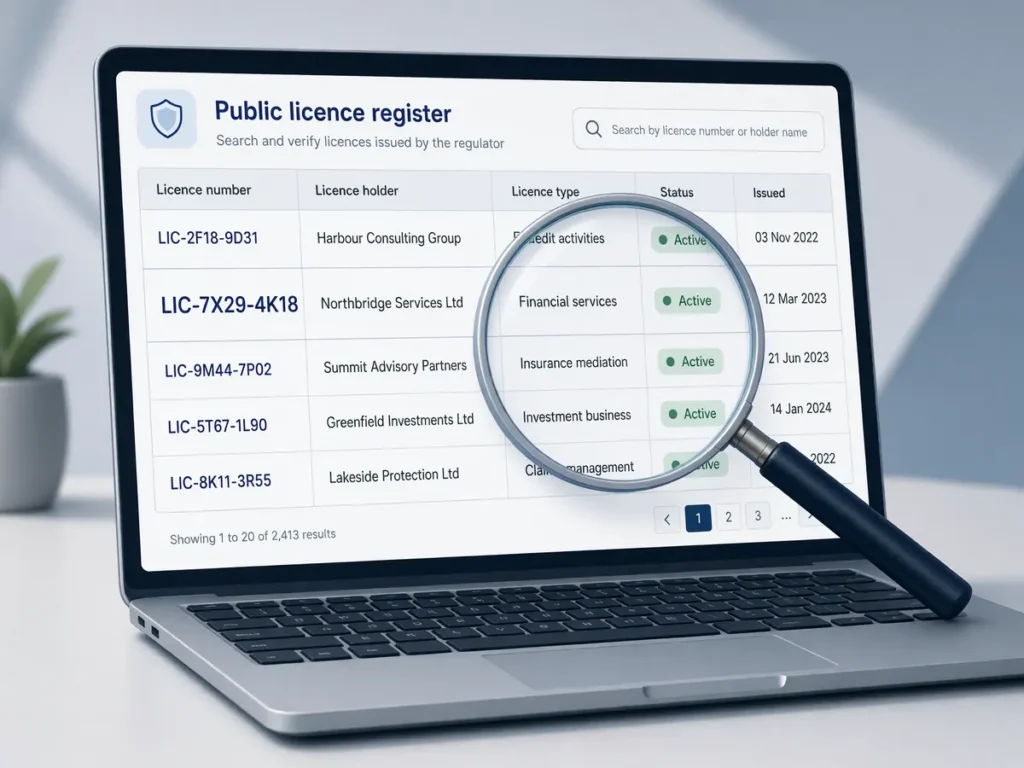
The licence badge in a casino’s footer protects you from nothing. It is an image file. What actually protects you is the entry behind it on a regulator’s public register, and the conditions attached to that entry. So when someone asks what does a gambling licence mean, the honest answer is narrow and specific: a named regulator has checked who owns the operator, where its money sits, whether its games have been independently tested, and it can take that permission away. It is not a quality rating, and it says nothing about whether you will win.
Which brings us to the news that prompted this piece. Wildz Group has announced it received approval for a Finnish gambling licence, and says it is the first operator authorised ahead of Finland’s market opening. It is a useful example precisely because of what is missing from it.
What actually happened with Wildz and Finland
According to CasinoBeats, the Malta-based Wildz Group says the Finnish National Police Board granted it a five-year licence, allowing it to operate once Finland’s regulated online market launches on 1 July 2027. The group operates Wildz Casino (including Wildz Sports), Caxino, Wheelz, Spinz, Chipz, Tuplaus and Blingi. Chief executive Sam Brown welcomed the approval in comments reported by iGaming Business (iGB).
Here is the part most coverage glides past. The National Police Board has not publicly confirmed the approval, according to LCB, so the claim that Wildz is first rests on Wildz’s own announcement. That is not an accusation of anything. Companies announce regulatory milestones before registers update all the time. But it is a clean illustration of the gap this whole article is about: an operator saying it holds a licence and a regulator showing that it does are two different pieces of evidence, and only the second one is worth anything to a player. Until the register says so, treat it as a company statement.
Two other details matter. The approval does not mean Finland’s licensed market is open, because it is not. And Finland is replacing a state monopoly with a multi-operator licensed market, which is why early approvals are newsworthy at all.
So what does a gambling licence mean in practice?
A gambling licence is a regulator’s formal permission for one named company to offer specified gambling products in one jurisdiction, granted after financial, fairness and conduct checks, and kept under ongoing supervision. The supervision is the part that does the work. A one-off approval with no follow-up is a certificate; a licence with reporting duties, audits and the threat of suspension is a leash.
Regulators are not interchangeable. Broadly you get national statutory bodies that sit inside a country’s legal system and license operators to serve that country’s residents, and offshore registries that license companies to operate from a territory without any particular connection to the players they serve. Both produce a “licence number”. Only the first gives a player in that country a regulator with any reason to act on their complaint.
How the licensing process usually runs
- Application, with corporate structure, ownership, funding sources and business plan disclosed.
- Due diligence on owners, directors and major shareholders, including criminal record, insolvency and source-of-funds checks.
- Financial review covering capital adequacy and, in most regimes, how player deposits will be held separately from operating money.
- Technical testing of games and the random number generator by an accredited laboratory, plus review of the platform, payout logic and reporting systems.
- Compliance sign-off on KYC and AML procedures, advertising rules, complaint handling and responsible gambling tools.
- Ongoing obligations after grant: periodic audits, incident and suspicious-activity reporting, licence fees, and inspections that can end in fines or revocation.
Steps one to five are why a licence takes months rather than days. Step six is why it means anything a year later.
What a licence protects that marketing cannot
Four protections do most of the real work, and none of them appear in a welcome bonus banner.
Segregated player funds. Most serious regimes require deposits to be held separately from the operator’s working capital, so your balance is not spent on salaries, marketing or server bills. It reduces the chance that an operator in trouble takes player money down with it.
Independently tested games. Accredited test houses verify that the RNG produces genuinely random, independent outcomes and that games pay at their stated RTP over the long run. Note what this does and does not mean: a tested 96% RTP slot still carries a 4% house edge, and testing confirms the maths is what the operator claims, not that it favours you.
A real complaints route. Licensed operators must have a formal complaints procedure and, in many jurisdictions, submit to an approved dispute resolution scheme or ombudsman once internal complaints are exhausted. Someone above the operator eventually reads your case.
Mandated responsible gambling tools. Deposit and loss limits, session reminders, cool-off periods and self-exclusion are licence conditions in regulated markets, not optional features. In several national regimes, self-exclusion works across every licensed operator rather than one site at a time.
What recourse do you actually have if things go wrong?
On a properly licensed site you have an escalation path; on an unlicensed one you have an email address and hope. That is the whole difference, and it only becomes visible at the moment a withdrawal stalls.
| Situation | Licensed in your jurisdiction | Unlicensed or grey-market site |
|---|---|---|
| Withdrawal withheld | Internal complaint, then regulator or approved dispute scheme | Operator’s own decision is final in practice |
| Operator goes insolvent | Segregation rules may protect deposits | Balance typically ranks with other unsecured claims, if traceable |
| Doubts about game fairness | Lab-tested RNG and RTP, regulator can audit | Nothing verifiable beyond the operator’s claim |
| Self-exclusion requested | Mandatory, often enforced across licensees | Voluntary, easily reversed or ignored |
| Bonus terms disputed | Advertising and fairness rules apply to terms | Terms can be changed or read against you |
Plenty of offshore-licensed sites pay out fine for years. The problem is that you learn which kind you joined at the worst possible moment, and the licensing red flags that expose illegal casinos”>warning signs are usually visible beforehand if you look.
Why state monopolies keep giving way to licensed competition
Finland’s 2027 opening follows a route several European markets have already taken: a state-run monopoly loses players to offshore sites it cannot regulate, so the government swaps exclusivity for a licensing regime that brings those operators inside the rules and inside the tax base. The logic is blunt. A monopoly can set perfect player protections and still fail if half the demand is being served by websites it has no power over.
The practical consequence for readers is that “licensed” is becoming the default trust signal rather than a premium one, because more jurisdictions now have a licence to issue. That cuts both ways. More real licences exist, and so do more plausible-looking claims to hold one.
Licensing is not one global standard
Frameworks differ sharply by country, and sometimes within a country. Some markets have a single national regulator covering all online gambling. Others split authority: in India, gambling law is largely a state subject, so rules on games of skill and chance vary between states and are not uniform across the country. A licence issued somewhere else does not change what applies where you live, and nothing here is legal advice. Check the regime that actually governs you rather than assuming the one you read about covers you.
How to check whether a casino is properly licensed
- Find the licence number and licensee company name in the site footer, usually near the terms link.
- Search that number on the regulator’s own public register. Go to the regulator’s website directly, not via a link on the casino.
- Confirm the company name on the register matches the company named in the terms and conditions, not just the brand.
- Check the licence covers online casino games and is active, not lapsed, suspended or limited to another product.
- Confirm the regulator plausibly covers players in your country, and check for conditions or past enforcement published against the licensee.
- If there is no verifiable number, no licensee name, or the register returns nothing, treat the claim as unproven.
I would not deposit anywhere that fails step two. Not because the site is necessarily dishonest, but because the entire value of a licence is that a third party can confirm it, and an unconfirmable licence has no value at all. That standard applies to announcements as much as footers, which is exactly why the Wildz claim stays in the “reported, not confirmed” column until Finland’s register says otherwise.
One last thing worth being straight about. A licence verifies fairness, fund handling and conduct. It does not make the games profitable, and it never will: the house edge survives every audit it passes. Use the deposit limits and the session reminders a licensed operator is obliged to give you, decide your spend before you play rather than during, and if gambling stops feeling like entertainment, use the self-exclusion tools and seek support. Those tools being there is what the licence bought you.