

If a casino tells you it is the best place in Las Vegas for big-time sports, what would you actually check before believing it? The honest answer is that no single property wins on every measure, and picking the best casino resort for sports events comes down to whether you care more about the book you bet into or the building you walk to. Those two things almost never sit in the same place.
Resorts World has just given us a clean case study in why the distinction matters.
Resorts World’s claim, in plain terms
Resorts World is arguing that its land is the best site on the Strip for a future NBA arena, not that its sportsbook is the best in town. Property president and chief financial officer Carlos Castro made the pitch in a statement to the Las Vegas Review-Journal, reported by Casino.org, framing the North Strip as “where the next chapter of Las Vegas is being written.”
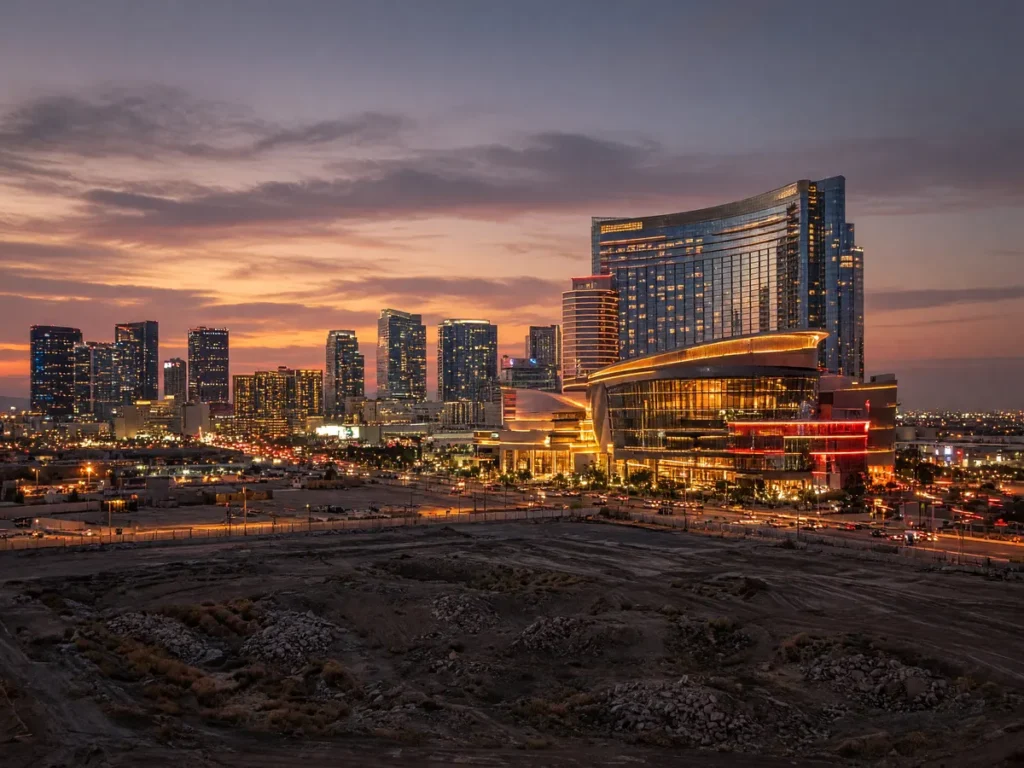
The substance behind the quote is real estate. Resorts World controls a 42-acre undeveloped footprint beside a $4.3 billion integrated resort that is already running, with Strip frontage at the front and back access via Sammy Davis Jr. Drive. Castro’s argument is that parking, utilities and access roads already exist, so an arena there would need less new support construction and none of the multi-year land assembly that other proposals face. He also points to the luxury corridor the property shares with Wynn and Fontainebleau, and to the traffic an arena would bring: exactly 41 regular-season home games out of 82 total games per season, plus concerts, combat sports and one-off events.
Two things to hold onto. First, this is a self-promoted claim, not an independent ranking of anything. Second, Resorts World does not get to decide. More than a dozen arena concepts have surfaced in recent years, the NBA shortlisted three ownership groups in September, and the venue follows the owner. Bill Foley, after teaming up with Jerry Colangelo’s Las Vegas Jacks group, is reported to favour using and renovating T-Mobile Arena rather than building new, with a reported $300 million in upgrades to the existing building. Until the league picks a franchise owner, every site pitch is a brochure.
What “best” should actually mean for a sports betting destination
A defensible definition of best rests on five things you can check yourself: the book’s size and technology, the prices and limits it posts, how far it is from the venue, what the resort gives you around the game, and what the room feels like when the game is on. Proximity is one of five, and it is the easiest one to claim.
Sportsbook size, tech and betting limits
Square footage is the headline number and the least useful one. What matters is seat count, whether those seats have screens and sightlines you can hold for a nine-hour football Saturday, how deep the odds boards go, and whether the in-play betting works on a saturated Wi-Fi network at 4pm on a Sunday in February. Limits matter more than any of it. A book that cuts you off at a few hundred dollars on a sideline market is a lounge with a betting counter attached.
Competitive prices, not just big screens
Price is where the real money is, and it is where marketing goes quiet. Half a point on a spread or a few cents of vig compounds across a weekend far faster than a free drink pays you back. Some Vegas books have built decades of reputation on posting early numbers and taking serious action; others shade their lines and rely on tourists not shopping. If you have never looked at how a trading desk builds and moves a number, it is worth understanding how sportsbook odds teams set and move your lines before you decide whose price you trust.
Proximity and game-day logistics
Distance to the venue is measured in minutes under pressure, not miles on a map. A property 15 minutes away with its own exit can beat one across the street if the one across the street empties 18,000 people onto a single crosswalk. Ask about pedestrian routes, rideshare pick-up points, whether you have to cross the Strip itself, and what happens to all of it when a concert and a fight land on the same weekend.
Hospitality, viewing experience and amenities
This is the bundle: room rate on the weekend you want, food and drink within staggering distance of a seat, viewing party setups and pool screens for daytime events, hospitality suites if you are travelling in a group, a high-roller lounge if your action justifies one, and comp amenities that actually track the play you give them. Comps are the quiet differentiator, because a large rewards network can be worth more over a season than any single promotion.
Where Resorts World actually stands
On the arena pitch itself, Resorts World’s case is strong and specific. Controlled land, existing infrastructure, dual access and an operating resort next door are checkable facts, not adjectives. If the NBA’s eventual owner wants to break ground quickly, that profile genuinely helps.
On everything else, the claim is doing work the facts have not earned yet. Resorts World opened in 2021 and runs a retail sportsbook, but I am not going to hand you a floor size, a screen dimension or a maximum bet for it, because I cannot verify current figures and a plausible-sounding number is worse than none. Those are exactly the details the pitch skips too. The statement is about acreage and access roads; it says nothing about posted limits, line quality, odds board depth or how the room handles a sellout crowd.
Then there is the awkward geography. Resorts World sits on the North Strip, which is the far end from T-Mobile Arena and Allegiant Stadium, the two venues that currently host major Vegas sporting events. For a Golden Knights game or a Raiders Sunday, it is a rideshare, not a walk. The property’s entire proximity argument is contingent on an arena that does not exist, at a site the league has not chosen, for a franchise that has not been awarded, with a target launch somewhere around the 2028-29 or 2029-30 season. That is a lot of conditionals inside the word “best.”
How it compares to the books bettors already name
Here is the same framework applied across four Vegas destinations. Treat the reputation column as reputation, because widely quoted screen and floor measurements circulate without consistent sourcing and I have not verified them.
| Property | Location vs major venues | Sportsbook reputation | Notable amenities |
|---|---|---|---|
| Circa | Downtown, a drive from the Strip’s venue cluster | Known for taking large action and running big handicapping contests | Multi-level book, Stadium Swim pool with a large screen |
| Westgate SuperBook | Off-Strip near the convention centre, no walkable venue | Long-standing name for early numbers, season win totals and its contest | Very large seated viewing hall, extensive video wall |
| Caesars Palace | Centre Strip, long walk or short ride to T-Mobile Arena | Big-room atmosphere, broad market coverage | Large seated book, deep rewards network, heavy dining options |
| Resorts World | North Strip, farthest from current venues; on-site only if an arena is built there | Newest of the four, no established line-shopping reputation | $4.3bn resort opened 2021, theatre, pool complex, 42 adjacent acres |
The pattern is the trade-off nobody in marketing wants to say out loud. The books bettors respect most for price and limits, Circa and Westgate, are the two that are nowhere near an arena. The properties nearest the venues trade on convenience and comps. Resorts World’s bid, if it lands, would be the first serious attempt to collapse that gap by putting the building next to the resort. Whether the book inside grows to match is unknowable today.
Why a casino’s own superlative means almost nothing
Work out the incentive and the claim reads differently. An arena next door delivers 41 guaranteed high-footfall nights a season, fills hotel rooms midweek, and makes 42 acres of dirt considerably more valuable. A press office arguing for that outcome is doing its job. It is not running a comparison, it is not applying criteria that could produce a losing result, and no part of the statement is falsifiable.
So treat self-declared superlatives as a prompt rather than information. “Best spot for an arena” is a claim about land. “Best for sports” is a claim about a book, and those get settled by posted prices, posted limits and what other bettors report, not by a quote in a newspaper.
Choosing your base for a big game
Before you book, run a short check of your own:
- Compare the posted spread and total at two or three books for your actual game, not a generic market.
- Ask the ticket window for the maximum on the bets you intend to make, including in-play.
- Map the real walk to the venue and the rideshare pick-up point, then look at what else is on that weekend.
- Price the room and food package against the book you would rather bet into, and decide which you are willing to lose.
- Check whether your play earns comps in a network you will use again, or only at one property.
One last thing worth being blunt about. Every price you see carries the book’s margin, the house keeps a share of total handle over time, and a comfortable seat does not change that. Set a figure you are content to lose before the first kick-off, and treat the weekend as entertainment you paid for.
The unresolved part is whether the gap between the best prices and the best location ever actually closes in Las Vegas. Resorts World’s pitch is the first plausible path to it. Until the NBA names an owner and that owner names a site, you are choosing between a good book and a short walk, the same choice bettors have been making for years.