

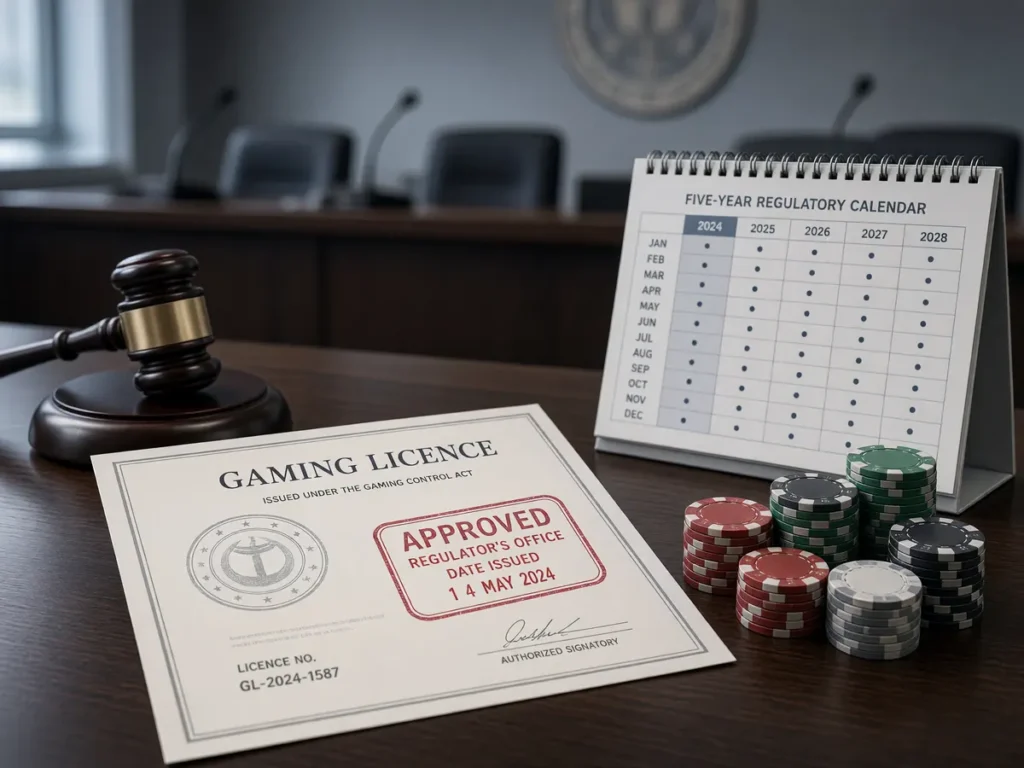
A gaming license is not a certificate you earn once and hang behind the cage. It expires. A casino license renewal is a periodic re-approval that lets an already-licensed operator keep trading, usually for a fixed term, after the regulator re-examines its finances, conduct and ownership. Pennsylvania just ran one in public: the Pennsylvania Gaming Control Board voted unanimously to renew the Category 4 license held by Stadium Casino Westmoreland RE, LLC, the operator of Live! Casino Pittsburgh, for a further five years.
That case is worth reading closely, because most players get licensing wrong in exactly one way. They treat the word “licensed” as a permanent property of a brand, like a logo. It is not. It is a dated claim about a specific legal entity, for a specific product, in a specific jurisdiction, valid until a specific date. Skip any one of those four conditions and the badge in the footer tells you almost nothing.
What the Pennsylvania Gaming Control Board actually decided
The Board found that Stadium Casino Westmoreland RE, LLC had fulfilled the obligations attached to its previously approved casino operator’s license and therefore qualified for renewal for an additional five-year period, according to reporting by G3 Newswire. The vote was unanimous.
The detail that matters more than the vote is the process behind it. The PGCB’s renewal procedure allows both the operator and the public to submit information relevant to the decision. A public input hearing was held in June 2025, at which Live! Casino Pittsburgh personnel filed exhibits and gave testimony on how the facility had operated since its previous renewal. Members of the public were also permitted to testify.
So this was not a rubber stamp administered by email. The operator had to put evidence on the record, under its own name, and anyone with a complaint had a scheduled opportunity to say so on that record. The casino has generated $647m in gross revenue since opening in November 2020, a number that tells you about scale and nothing at all about conduct. Revenue and compliance are separate files, and it is worth being clear-eyed about what rising casino revenue figures actually signal before reading them as a seal of approval.
Renewal is a different exam from the original application
A first-time license application asks whether an applicant should be allowed to operate. A renewal asks whether an operator that has been running for years still should. The first is a projection; the second is a report card with evidence.
| Stage | Core question | What the regulator mainly examines |
|---|---|---|
| Initial licensing | Is this applicant suitable to be licensed at all? | Source of funds, business plan, ownership disclosure, background investigations, proposed controls |
| Renewal | Has the licensee met its obligations and does it remain suitable? | Track record since the last approval, compliance file, current finances, any change of ownership or control, public input |
That difference is why a renewal carries more information for a player than an original grant. Anyone can look good on paper before they open. Clearing a review after five years of actual trading, with the regulator holding the complaints log, is a harder test.
What a gaming control board digs into before signing off
Renewal reviews vary by jurisdiction, but the categories regulators work through are broadly consistent. The specifics below are the general framework rather than details confirmed in the Pennsylvania decision.
Financial suitability and ownership structure
Regulators want to see that the licensee remains financially sound enough to pay winnings, cover liabilities and fund its own compliance obligations. That means audited accounts, capital position, and a current map of who ultimately owns and controls the entity. A quiet change of control is one of the things renewal exists to catch, because the people vetted at the original licensing may no longer be the people in charge.
Compliance history, violations and fines
Every enforcement action, consent agreement and penalty since the last approval sits in the file. Crucially, a clean renewal does not mean a spotless history. It means the regulator judged the history, including any penalties and the corrective action taken, to be consistent with continued suitability. An operator can be fined and still be renewed; what gets you refused is a pattern the board no longer trusts you to fix.
Responsible gambling and player protection
Reviewers look at self-exclusion administration, staff training, advertising conduct, handling of underage access, and whether player-facing tools like deposit and loss limits actually function. In mature markets this has moved from a box-tick to a documented programme with audit evidence behind it.
Background checks on operators and key executives
Suitability attaches to people, not only companies. Directors, substantial shareholders and designated key employees are re-screened. New senior hires generally need their own approval, which is why personnel changes can surface in a renewal file years after they happened.
Why a renewal vote beats a logo as a trust signal
A license is continuous supervision with a scheduled audit, not a one-off stamp. Between renewals the regulator can issue conditions, levy fines or suspend operations; at renewal it decides whether the whole relationship continues. That is the practical reason the Pittsburgh decision is informative: a board with subpoena power, a complaints record and a public hearing looked at five years of trading and concluded the operator had met its obligations.
Be careful about what that does not cover. A renewal reflects the regulator’s confidence on the day of the vote. It does not guarantee future conduct, it does not make the games fairer, and it does not remove the house edge built into every one of them. What it buys you is recourse: a named authority with the power to investigate your complaint, which is exactly what you lack at an unlicensed site. If you want the longer version of that argument, our explainer on what an online casino licence actually means for player safety walks through the protections a licence does and does not deliver.
Checking an operator’s licensing status yourself
This takes about three minutes and it works for online platforms as well as land-based venues.
- Start at the regulator, not the casino. Go to the licensing authority’s public register directly, for example the Pennsylvania Gaming Control Board, rather than clicking a badge on the operator’s own page.
- Search the legal entity, not the brand. Live! Casino Pittsburgh is the brand; Stadium Casino Westmoreland RE, LLC is the licensee. Footers usually name the corporate entity somewhere, and a brand that will not tell you which company holds the licence has already answered your question.
- Read the status field, not just the hit. You are looking for active or current, plus the expiry or next renewal date, plus any conditions or restrictions recorded against it.
- Match the licence to the product and your location. A land-based casino licence does not authorise an online casino, and a licence valid in one jurisdiction does not make the site legal where you are.
- Cross-check the number displayed on the site against the register entry. A mismatched number, a transposed digit, or a licence that belongs to a different company is the classic tell on a cloned or white-label-gone-rogue site.
- Treat vague claims as absent claims. “Licensed and regulated” with no named authority and no number is marketing copy, not a licence.
When a licence is not renewed
Non-renewal or revocation means the operator must stop offering gambling in that jurisdiction, and the consequences land on players as well as shareholders. In well-regulated markets the regulator usually supervises a wind-down, including the handling of player balances and the closure of accounts. The weaker the jurisdiction, the thinner that safety net gets, and the harder it becomes to recover a withdrawal that was pending when the shutters came down.
There is also a middle outcome that rarely makes headlines: renewal with conditions, or renewal for a shorter term, which signals the regulator wanted leverage. None of this applies to Live! Casino Pittsburgh, whose licence was renewed in full for five years. It is the generic risk profile of the category, and it is the reason the expiry date on a licence is worth knowing.
The rule of thumb worth adopting
Stop asking whether an operator is licensed and start asking by whom, for what product, under which legal entity, and until when. The Pittsburgh renewal is a useful benchmark precisely because all four answers are public, dated and checkable by anyone with a browser. If an operator cannot survive that same four-part question, the problem is not that you were too suspicious.
And hold one thing separate from all of it. Regulation governs how an operator behaves, not whether you win. Every game in a licensed casino still carries a house edge, and licensing is no reason to stake more than you can comfortably lose. Set deposit and loss limits before you need them, use the self-exclusion tools the regulator obliges operators to offer, and if gambling has stopped being entertainment, contact a national helpline rather than a casino’s support chat.