

Matchbook’s Betdaq deal, and the myth it exposes
An exchange is not a bookmaker that happens to price more generously. It is a different machine entirely, and the price you see on it only exists because another person has put money behind it. That distinction got a fresh airing in October, when Matchbook completed its acquisition of fellow betting exchange Betdaq for an undisclosed sum, with the deal reported by the Racing Post to also involve Racecourse Data Technologies (RDT), a supplier of hardware, betting software and support to on-course bookmakers. Matchbook said Betdaq would stay open for trading until 21 October, with customer accounts available for withdrawals until 4 November.
Two order books becoming one is a liquidity story before it is anything else. Matchbook chief executive Ronan McDonagh said both exchanges were built on the principle that bettors benefit from market-driven prices rather than bookmaker margins, and that combining them was expected to deliver better prices and deeper liquidity than either could offer alone. That is the claim worth examining, because “deeper liquidity” is exactly the thing most betting exchange explainers wave at without ever telling you how to check it. Any detail of the deal beyond what Matchbook and the Racing Post have stated should be treated as unconfirmed.
What is a betting exchange, in plain mechanics
A betting exchange is a marketplace where bettors wager against each other rather than against the house. You either back an outcome (bet it will happen) or lay it (bet it will not), and the platform matches your order against someone taking the opposite side, then takes a commission on net winnings instead of building a margin into the price.
That is the whole model. Peer to peer betting, with the operator acting as the venue and the clearing house rather than as your counterparty. Betdaq, founded by Dermot Desmond in 2000, was among the earliest exchanges to run it; Matchbook followed in 2004.
Back and lay, one example each
Backing is familiar: you stake ₹1,000 on India at 2.50, and if India win you collect ₹1,500 profit. Laying is the part that trips up newcomers. If you lay India at 2.50 for ₹1,000, you are the one offering that bet to someone else. India lose, you keep their ₹1,000 stake. India win, you pay out ₹1,500.
Note the asymmetry, because it is where first-timers get hurt. Your liability as a layer is stake × (odds − 1), not the stake. Lay a 20.00 longshot for ₹1,000 and you are risking ₹19,000 to win ₹1,000. I would not lay anything above about 5.00 until you have watched your own liability figure move on a few small bets, whatever the implied probability tells you about how often that outcome lands.
Who actually sets the odds
Nobody at the exchange sets them. Prices come from the orders users submit, so the market is the pricing committee: the best available back price is simply the highest odds someone is currently willing to lay, and the best lay price is the lowest odds someone will accept to back. At a bookmaker, by contrast, a trading desk compiles and moves the line, and the operation is a far more deliberate one than most bettors picture, as anyone who has looked at how sportsbook odds teams set and move their lines will recognise.
Exchange vs bookmaker odds: the contrasts that matter
Five differences do most of the practical work. Everything else is interface.
| Mechanic | Betting exchange | Bookmaker |
|---|---|---|
| Who sets the price | Other users, via the order book | The operator’s trading team |
| How the operator earns | Commission on net winnings | Margin (overround) baked into every price |
| Betting against an outcome | Yes, by laying | Only indirectly, via opposite selections |
| Bet acceptance and size | Limited by money available at that price | Limited by operator-set stake caps and account restrictions |
| Cash out | You do it yourself by placing an opposing bet | A price the operator quotes you, margin included |
The cash out row deserves a second look. On an exchange you close a position by taking the other side at the current price, so you can calculate your own exit and decide whether it is worth taking. A bookmaker’s cash out button is a product priced in the operator’s favour. That transparency is the strongest genuine argument for the exchange model.
Liquidity is what decides whether your bet exists at all
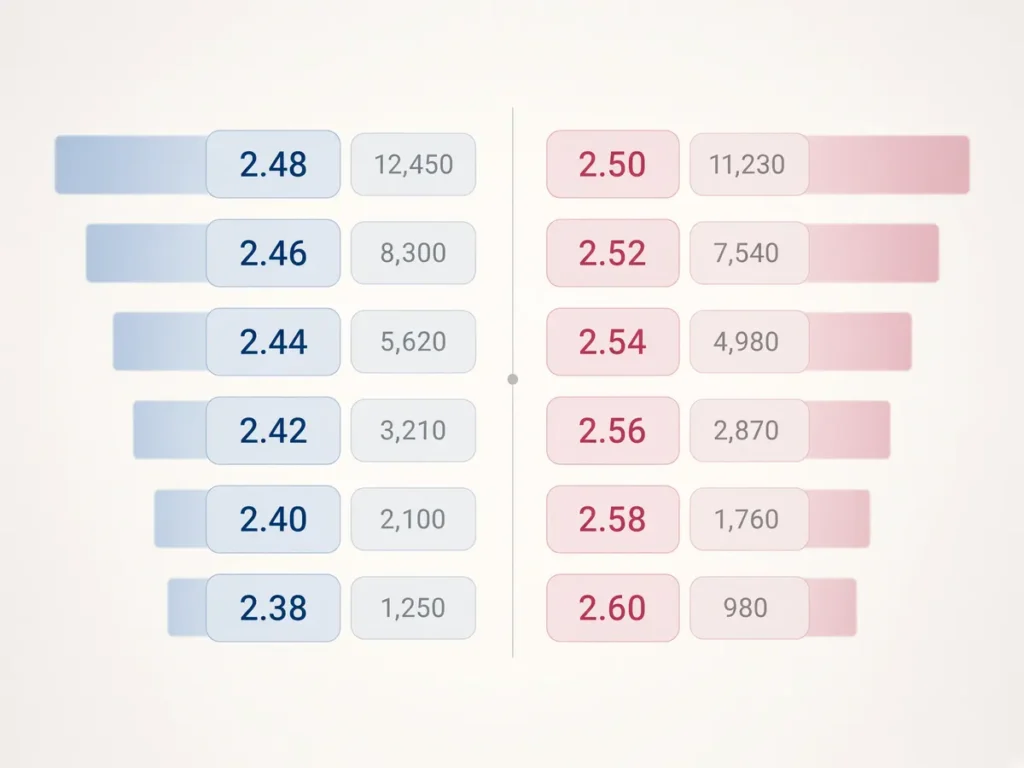
Liquidity is the amount of money sitting in the order book waiting to be matched at each price. Thin liquidity means three things at once: the gap between the best back and lay price widens, your order may sit unmatched at the price you wanted, and the maximum you can get on shrinks to whatever the other side has offered.
A Premier League match-odds market on a well-used exchange might show lakhs matched and a back/lay spread one tick wide. A third-set handicap in a minor tennis event might show a few thousand matched, with back 2.80 and lay 3.40. On that second market, the “better price” argument for exchanges collapses, because the only price you can actually get is worse than the bookmaker’s.
This is where the Matchbook claim about the Betdaq acquisition deserves a careful reading rather than a nod. Merging two user bases genuinely does pool capital into one book, and for markets both platforms already covered well, you should expect tighter spreads and more money available at each price than either had alone. What consolidation does not guarantee is that every Betdaq customer migrates, or that the long tail of niche markets suddenly becomes tradable. One venue with a combined pool is also one fewer venue competing for your order. Treat “deeper liquidity” as a reasonable expectation on the main markets and an open question everywhere else, and verify it on screen rather than in a press release.
Commission versus overround, with the numbers
Exchanges charge a percentage of your net winnings on a market; bookmakers take their cut in advance by shading every price. Take a straight two-way market where both outcomes are genuinely 50/50. A bookmaker offering 1.90 on each side is pricing each at an implied 52.63% probability, so the book totals 105.26% and the overround is roughly 5%. You pay that on every bet, win or lose.
Now the exchange. The true price is 2.00 and that is what the book shows, because no margin has been inserted. Back ₹1,000 and a winner returns ₹1,000 profit. Apply an illustrative 2% commission on net winnings and you keep ₹980. The bookmaker’s 1.90 would have paid ₹900. Commission rates vary by exchange and often by activity tier, so check the terms rather than assuming a number, but the shape of the comparison holds: a loss costs you nothing extra on an exchange, while the bookmaker’s margin applies regardless.
The honest footnote is that both models are set up so the operator profits over time, and neither changes the fact that you are betting into uncertain outcomes. An exchange reduces the drag on your returns, it does not remove it.
What you actually gain and give up
Worth having:
- Prices unburdened by overround, which matters most on heavily traded markets
- The ability to lay, so you can bet against an outcome directly
- Self-managed trading positions, including greening up across price moves
- A visible order book, so you can see what money is behind a price before committing
Worth weighing:
- A steeper learning curve, with liability on lay bets as the main trap
- Liquidity risk, which bites hardest in niche markets and in-play moments
- Commission reducing winning returns, particularly if you grind small edges
- Fewer sweeteners than bookmakers, since there is no margin funding big promotions
- Market coverage that can be patchy compared with a full sportsbook
If you bet occasionally on big football, cricket or racing markets, the exchange model is worth learning. If your betting lives in obscure leagues, you may find the book too thin to be useful, and no amount of consolidation fixes that in the short term.
Three checks before you click back or lay
- Read the matched amount on the market, not just the price. A big number means your bet will likely fill; a small one means the displayed odds are close to decorative.
- Measure the back/lay spread. A one or two tick gap is a healthy market. Back 2.80 against lay 3.40 tells you there is no real market, only two hopeful orders.
- Check the money queued at the price you want. If only ₹2,000 is available at 2.00 and you want ₹10,000 on, the rest fills lower or not at all.
Two more habits save grief. Confirm your liability figure on every lay before submitting, and know your tax position: winnings from online gaming in India are taxable, with TDS applied to net winnings, so plan around the net rather than the gross. Matchbook’s wider interests also stretch into prediction markets through ADI PredictStreet, and if that boundary interests you, the mechanics of prediction markets versus traditional sports betting are closer to exchange logic than to a sportsbook’s.
Set a deposit or loss limit before you start, not after a bad week, and treat the order book as information rather than opportunity. The open question from this deal is not whether exchange pricing is cleaner than bookmaker pricing, which the arithmetic settles. It is whether one consolidated pool makes the markets you personally bet on any deeper, and only your screen can answer that.